Join us for Tripawds Podcast Episode #137, to learn about brand new research on how short-legged, long-bodied chondrodysplastic dogs adapt after limb amputation. You might be surprised to learn the answers!
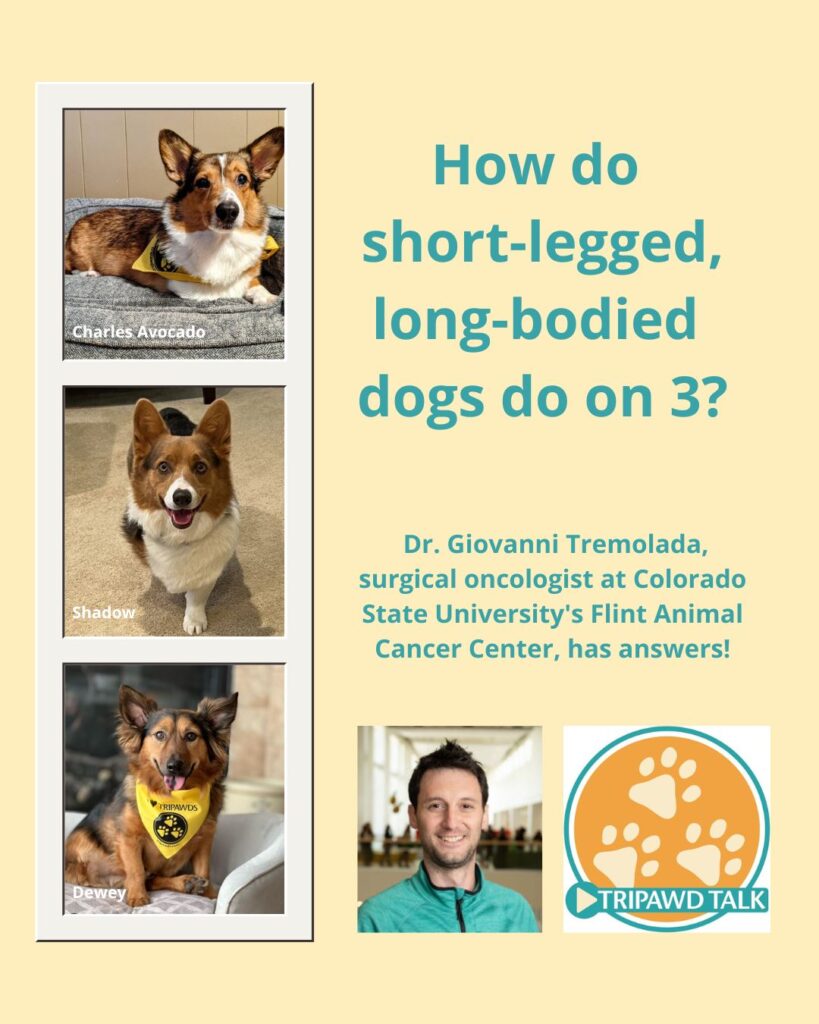
Our guide for this episode is Dr. Giovanni Tremolada, surgical oncologist at Colorado State University’s Flint Animal Cancer Center.
You’ll love this fun discussion about a question many pet parents of chondrodysplastic breeds have wondered when faced with the amputation decision.
Can short-legged, long-bodied dogs successfully adapt after losing a limb?
Breeds like Dachshunds, Corgis, Basset Hounds, and French Bulldogs have a unique body structure that often raises concerns when amputation is recommended.
Many vets even discourage pet parents from amputation surgery for their chondrodysplastic dog!
But now thanks to new research in a small group of Tripawd dogs, veterinarians can rest easy knowing that for the most part these breeds adapt pretty well after losing a leg.
Conclusions from the Study on Chondrodysplastic Amputee Dogs
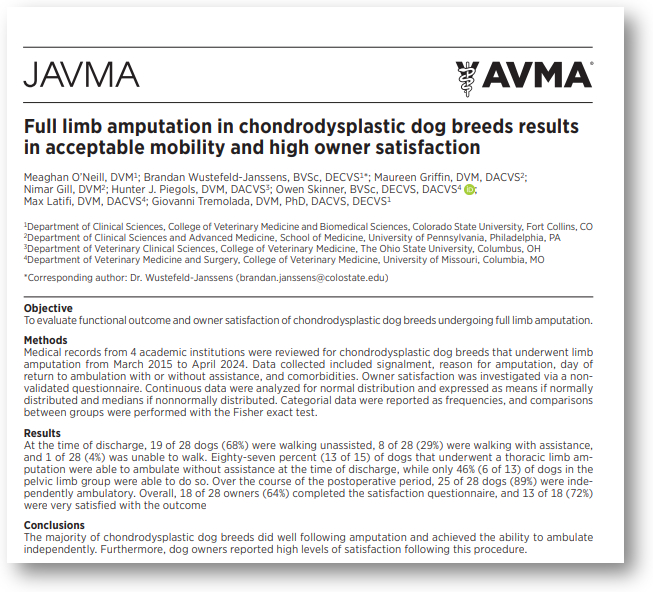
Nearly 90 percent of the dogs in the study were able to walk on their own after surgery, showing recovery rates similar to other tripod dogs.
Pre-existing orthopedic conditions like arthritis or cruciate ligament disease did not appear to significantly impact mobility outcomes.
Maintaining a healthy weight and considering rehabilitation therapy can play an important role in long-term mobility and comfort.
Just check out some Tripawd hero examples in the Resources section below.
What You Will Learn in This Tripawd Talk Episode
In this episode, Dr. Tremolada shares insights from a multi-institution retrospective study examining how these chondrodysplastic breeds recover after limb amputation and what their outcomes can tell us. We also talk about:
- mobility
- recovery timelines
- orthopedic considerations
- the role of factors like body weight and rehabilitation
- how these dogs adapt to being a Tripawd
- what pet parents can expect during recovery
- and how to support mobility, comfort, and quality of life
You’ll learn why these dogs may adapt better than many people expect, and why careful evaluation before surgery is still important.
Tripawd Talk #137: Short Legs, Strong Spirit
Listen to the podcast on the go, watch the YouTube video below, and check out the full transcript to get into the details.
Subscribe to Tripawd Talk Radio in your podcast player app!
Read the 2026 JAVMA Study: Full Limb Amputation in Chondrodysplastic Dog Breeds
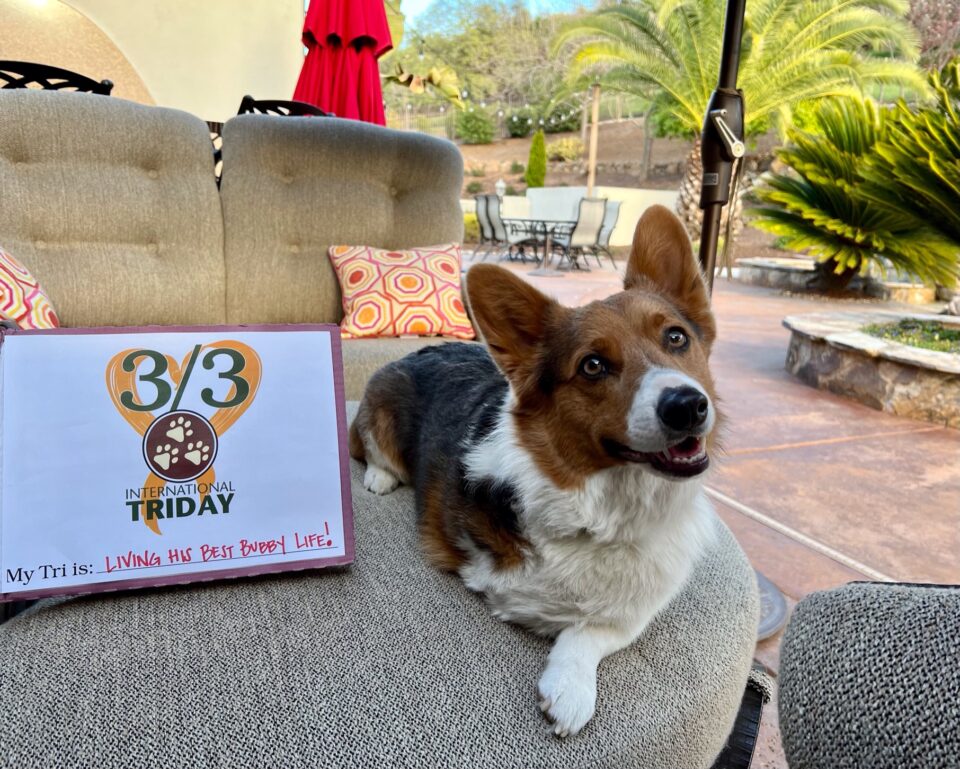
This episode is dedicated to the amazing, beautiful life of our community’s newest angel, Shadow the Corgi.
Watch / Listen to Tripawd Talk Radio Podcast #137 on YouTube
About Dr. Giovanni Tremolada
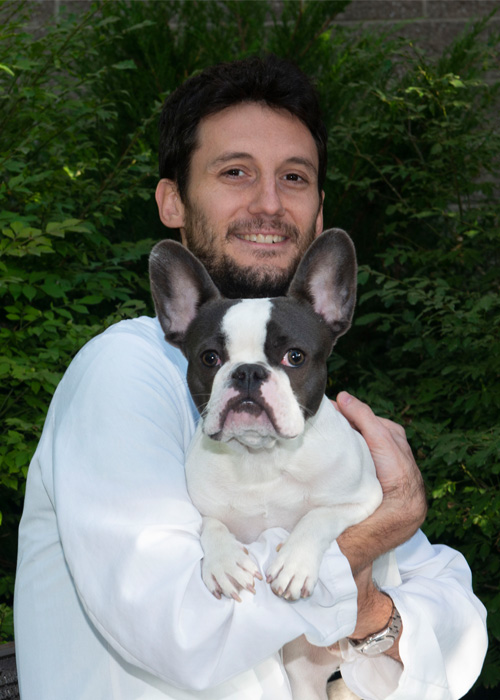
Dr. Giovanni Tremolada, DVM, MS, Ph.D., DACVS-SA, DECVS, is a veterinary surgical oncologist and Clinical Assistant Professor at Colorado State University’s Flint Animal Cancer Center.
He specializes in surgical care for pets with cancer and has a research background in fetal development and animal models.
Resources and Examples of Chondrodysplastic Amputee Dogs
- Colorado State University’s Flint Animal Cancer Center
- Tripawds Support Circle
- Charles Avocado VanGogh, the three-legged corgi
- Charles and Dewey the Corgi Amputees
- Tripawd Corgi Hero Shadow
- Penny the Corgi Shepherd
- Lora the Tripawd Dachsy
- Life with Tri-Pug Maggie
- Clenna the Pug
- Elly the TriPug
Tripawd Talk #137 Full Transcript
Research About Amputation for Short-Legged, Long-Bodied Dogs
Studying Amputation Outcomes in Short-Legged, Long-Bodied Tripawd Dogs, with Dr. Tremolada, Tripawd Talk
TRIPAWDS: Alright, Dr. Tremolada, I’m so happy you’re here today. Thank you so much for joining us.
DR. TREMOLADA: Thank you for having me. It’s a pleasure to be here.
TRIPAWDS: You bet. Now, we are going to talk about a very specific topic today. And that topic is short-legged, long-bodied Tripawds. And I found it really fascinating that you actually studied these types of tripawds because they’re not that many of them.
DR. TREMOLADA: Yeah, no, you have a really good point there. Definitely, they’re known for other issues most of the time, like breathing issues, not as much, needing an amputation, but sometimes they still need them.
Why Short-Legged, Long-Bodied Dogs Are Often Considered Poor Amputation Candidates
TRIPAWDS: Yeah, and it is unfortunate, of course. We never want a dog to lose a leg, and we often see other breeds besides these. I have a feeling it’s because, for a long time, people and veterinarians have just thought these dogs don’t do well on three legs. Over the years, they’ve been rare. Has that been your experience, too?
DR. TREMOLADA: Yeah, that has been my experience, too. With the study that we’re trying to publish soon, hopefully. We’re going through some revisions right now, pretty much. We had to have multiple institutions try to get a decent number of cases. So, definitely not super, super, super common. Here at CSU, we do a large amount of amputations, but usually it’s more like the giant breed type of dog that is the most common.
How Dr. Tremolada’s Personal Experience Led to This Research and Why “Chondrodysplastic” Matters
TRIPAWDS: Yes, that’s been our experience with the members that join our community. Now, you have a certain French bulldog named Giacomo, I noticed on your bio page.
How has he influenced your interest in studying? And forgive me if I pronounce this incorrectly, but is it chondrodysplastic breeds?
DR. TREMOLADA: That is perfect. Yes, chondrodysplastic breed.
TRIPAWDS: Oh, yay, okay. So, did he have some kind of impact on your reasons for studying?
DR. TREMOLADA: I would say so. They’re becoming really, really popular as far as breeds. Having one, you try to look it up, and there’s not a lot that is specific for these types of dogs. They’re quite different from an anatomic standpoint compared to a lot of other dogs.
So, probably not just for amputation, but there may be other things that we cannot relate 100% to the general population, let’s put it this way. So, definitely that played a role. And also, they’re quite fun dogs, so it’s nice to have a little bit more information about those.
TRIPAWDS: Yeah, absolutely. That is a huge reason why, in our community, we want people to have their tripawd evaluated by a rehabilitation therapist who can give their dog specific advice for their mobility needs after they lose a leg, because a French bulldog is going to move a lot differently than a Doberman or a Great Dane.
So, it’s very specific and individual to the dog when they move, but there are commonalities, and I guess that’s what you have studied for this type of breed.
Now, you partnered with other universities. Do your other colleagues all have these types of dogs? What made them want to jump in on this study?
DR. TREMOLADA: No. If I remember correctly, I’m the only one to have a little short, long-body dog in the population of people that contributed cases. But they’re all Frenchie lovers, let’s put it this way, I can tell you that. At least my dog.
How the Study Was Designed and What It Examined
TRIPAWDS: And, like you said, they are very popular, and so they do have these needs that need to be looked at. Now, tell me a little bit about the study. When did it start, and how many dogs did you look at?
DR. TREMOLADA: Yeah, so, everything happened by chance. We had this basset hound coming in through our oncology service here at Colorado State University.
And, unfortunately, it had a bone tumor, that is the most common cause, for me at least, to perform an amputation. The owner was really nice. She was in the medical field. I don’t remember if she was a physician or a nurse.
She asked a really good question about how these types of dogs would actually be able to compensate after not having a leg, especially because this dog was also a little bit overweight. Let’s put it this way: she was a little chunkier.
And so that kind of opened a can of worms. I tried to look up if there was anything specific about this, and I couldn’t find anything. So that’s the driving idea for the study for us here.
She’s our patient number one who helped us make this study happen. It’s still a fairly small study. It’s less than 30 dogs that are involved because, again, as we mentioned before, they’re popular, but luckily, they don’t tend to get these types of bone tumors in the study. There are not just tumor dogs, but also for trauma that have been amputated.
That may be a little bit more common. But most of the time, if the owner has the financial ability, the treatment choice would be repairing that fracture instead of amputating, so it was not super easy to have a really large number of studies if you look for the past 10 years.
TRIPAWDS: Yeah, I would agree. I mean, in all of our experience, we have one blog post in 18 years about a dachshund and a corgi who lost a leg. And I actually interviewed their parents one time, and they just talked about how well they did, and it was really surprising.
So, I kind of use that as a resource when people join us, and they have this type of breed that’s going to lose a leg. That’s the only resource I’ve had all these years. So I can’t wait till your study is published so that we can compare it.
DR. TREMOLADA: Hopefully, it’s going to be soon. How about that?
How Dogs Adapt After Amputation — Key Findings from the Study
TRIPAWDS: Right, right, let’s hope. So, until then, we have to rely on your information to convey what you discovered, and one of the things that you found was that it’s almost 90% of the dogs were able to walk on their own after surgery. So, what did you learn by looking at that, and what does it say about how they adapt despite having such an unusual body type?
DR. TREMOLADA: Yeah, I would say, in general, dogs are a pretty resilient animal compared to us. After surgery, they tend to bounce back really quickly. I think that definitely there’s a little bit of bias in the selection of these cases, because if we thought they were good surgical candidates, then we’d move forward with the procedure. So we were not able to see how many were pushed out that maybe didn’t end up having an amputation for whatever reason.
But I would say, no matter what, it’s still good information because if there are not major red flags, it seems that this dog can do really, really well, and it’s the same percentage of being able to ambulate without assistance in the general population like the normal, shaped dog. Let’s calculate it this way, yeah.
TRIPAWDS: Now, I should have clarified in the beginning, was this a retrospective study where you looked back on how they did?
What “Retrospective Study” Means for Pet Parents
DR. TREMOLADA: Yeah. It was a retrospective study. Doing a prospective study, from the standpoint of the value of the data, would definitely be much better, but also way more challenging to try to get those cases. It would be several years just to collect a small number of cases. So unfortunately, it was not possible.
TRIPAWDS: Okay, so it’s my understanding, then, that you sent a survey out to people. How far out were the dogs from surgery when they received the survey?
DR. TREMOLADA: We’re a little bit all over the place. There were some that were closer, maybe a couple of months after the procedure, and others that were years after. So even at this point, it’s a little bit challenging, because some people may not have recalled everything correctly.
That’s the problem with any questionnaire that you ask, “What happened 5 years ago?” So, I personally wouldn’t remember exactly. But again, the vast majority of those clients were really happy with the outcome. There was, I think, just a single client that answered the survey.
Not everyone, unfortunately, answered the survey. Just one that was highly disappointed. They wouldn’t have done the same procedure, but that was mainly because the tumor grew back in 8 months’ time frame. So, it was not indicative of how well the dog was able to ambulate after the procedure.
TRIPAWDS: I find that really interesting because in our very unscientific Tripawds quality of life surveys that we’ve done over the years in our community, that’s been about the type of response that we get. We get usually 95% of people say they were happy with how things turned out, and even when they didn’t get the time frame that they had hoped for with their dog or cat.
But usually there’s one or two people who were very disappointed, and it’s often because, like you said, the cancer came back very quickly, or the dog had issues going into surgery, and they got complicated after surgery. So, it’s a pretty common finding there, even for a type of dog like this.
Some of these dogs did have orthopedic issues. What types of issues did they have, and how did those issues go over after amputation? Did they get worse? Did they stay the same?
DR. TREMOLADA: Yeah, so, some of these dogs have the classic orthopedic disease, some of them have some cranial cruciate disease, some generalized osteoarthritis or hip dysplasia that are pretty common, especially bulldogs and Frenchies. They don’t have perfect hips, let’s put it this way, but they can compensate pretty well. They have really large muscles, and usually they tend to do pretty well.
I would say in the general population, dogs with osteosarcoma are most likely to be on the older side, so it’s unlikely they’re going to be 100% sound on their legs.
We didn’t see a true difference in how this dog adapted after surgery compared to the one that, at least on physical examination, we were not able to find out anything. Some of them had radiographs, some others were just based on the findings that we had during our exam.
There was one dog that had a little bit of neck stiffness, suspected, intervertebral disc disease (IVDD) in the neck. And, that one still did okay, a little bit of an episode of ataxia, so wobbly walk a few months after the surgery. Suspected flare-up of disc disease, but we didn’t end up doing an MRI or any advanced imaging, so it’s still based on physical exam findings. It cannot be confirmed 100%, but probably is the thing that makes the most sense.
TRIPAWDS: That is super interesting. So, basically, there are very few, if any, dogs will go into an amputation procedure with absolutely perfect hips, absolutely perfect everything, because they’re older and have lived a longer life with more activity. Is that what you’re saying?
DR. TREMOLADA: Yeah, this is what I was saying. It’s gonna be challenging to find. I’m sure that if they radiographed me now, they’re going to find those things. So, I think the older you get, it’s what’s going to happen to all of us.
Front Limb vs Rear Limb Amputation in Short-Legged Dogs
TRIPAWDS: Yeah, just like people, exactly. Now, in your study, it stated that you found some front leg amputees did well. They recovered faster than dogs who lost a back leg. And normally, we always hear it’s so much harder for a dog with a front leg, but how did that impact your thoughts about this whole process? I was surprised by that.
DR. TREMOLADA: You were not the only one. We were surprised too, to be honest. I think that what we usually see in the general population is that the dog with the front limb amputation tends to adapt a little bit more slower compared to the hind limbs.
We came up with a couple of possible explanations for these types of dogs. Again, unfortunately, being a retrospective study, we were not able to ask all the questions we wanted or track all the data that we wanted. One of the possibilities is that these dogs received an epidural at the time of surgery, and maybe they were still discharged the day after, being a little bit smaller as they’re quite easier to handle compared to a Great Dane if you have to take them out to go to the bathroom.
So maybe were not 100% ambulatory, but if we think that that discrepancy in being able to move around was just related to anesthesia, they may have been just sent out home a little bit faster compared to a giant dog, where it’s way more challenging to try to deal with a 90-kilogram dog compared to a 10-kilogram dog to take outside and in the backyard to pee.
Another potential reason that can explain this is maybe it was not just a walking challenge, but more like a standing challenge, being able to raise from a sitting position, because they have these short and squatty legs, and once they were actually up, they could go and walk more easily.
We were not able to tease out what was the difference from the records that we were reviewing. So, both of them are just theories, unfortunately, and cannot be proven 100%, but we tried to come up with some explanation for this finding.
TRIPAWDS: That kind of does make a lot of sense. I mean, the lower to the ground you are, the easier it is to either sit down or get up. I’m only 5’2”, barely, and I know for a lot of things, it’s super easy for me to, like, sit in a chair than it is for a really tall person. They might take a lot longer to sit down or get up.
A lot of these breeds are prone to issues like IVDD or other types of long-bodied dog diseases. If a dog is being recommended for amputation surgery, what should people keep in mind? If their dog doesn’t already have the disease, do you think that they might be more prone to having that disease actually happen after amputation? Is there a higher risk of it occurring?
DR. TREMOLADA: Yeah, in our population, we were not able to demonstrate that, but personally, I would still be concerned about that. I think it’s really important to have a good neurologic/orthopedic exam before the amputation for these dogs, just because if they already are showing some signs, maybe it’s a little bit of a different conversation with the owner, saying, “Probably it’s going to be fine, but something may happen.”
They need to be informed about that, so that it’s not going to be a surprise if a few months after, they blow a disc. I have to say that never happened to me with these types of dogs. I can recall only a large breed dog that had a disc after an amputation, a few months after. That dog ended up doing pretty well, but definitely, there’s a lot of work from the owner in the beginning, because when they’re not ambulatory, and they’re big dogs, it takes a lot of help for them to be able to move around. It ended up actually living more than a year, and still with a little bit of support with the Help ’Em Up–type harness, just to make sure that it was able to ambulate well.
But to me, again, it’s not 100%. If that happens, then it’s game over, I think. There are likely other options if you have a really committed owner.
Rehabilitation, Weight Management, and Long-Term Quality of Life
TRIPAWDS: Yeah, that’s definitely something to consider. Do you know if any of these dogs had rehab therapy after surgery?
DR. TREMOLADA: We didn’t look too much into that, because it was difficult to get. Definitely, a subset, yes. Here, at CSU, we tend to recommend, at least in the immediate post-operative, to have some PT done, and some exercise to be done at home. And I think it helps quite a bit, to be honest, especially for the large breed dogs.
The other thing that, in this specific case, would be important is what is the reason why we amputated these legs? Because, for a neoplastic process, where maybe your prognosis is not going to be that great, it’s going to be around a year-ish of survival.
You may not need too much support, but if you were hit by a car and fractured that leg, and then you have your normal lifespan, that you have to put a lot of stress on the other joints, definitely try to be a little bit more proactive. Try to do as much physical therapy as possible, potentially having products to help with the discomfort.
They’re all things that are quite important, together with weight. Weight is probably one of the biggest things to keep in consideration. And I know that bulldogs in general, French or English, tend to be on the chunky side, let’s put it this way. So, especially if you have a traumatic reason for amputating.
TRIPAWDS: Yeah, weight is a huge issue. Obviously, it’s so important to help your dog lose weight before surgery if you have the luxury of time, but even after, is it possible for them to drop a healthy amount of weight and make their mobility better? I know this is kind of a curveball question, but what do you see in your practice?
DR. TREMOLADA: No, it’s what we recommend when we see a dog that needs an amputation and doesn’t have the luxury of being able to wait to lose a little bit of weight before surgery. One of the things we tend to stress is at least trying to lose a few pounds. Even just a few pounds can make a pretty big difference.
It doesn’t have to be immediately after, but it’s definitely going to help long-term. And as I was saying, especially for those traumatic amputees that have a normal lifespan, they have the time to lose the weight. So, I think that would be a great suggestion, no matter the size and the shape of your dog. Let’s put it this way.
TRIPAWDS: Good point. Thank you for mentioning that. Now, this was a very specific, very short study. Do you plan on doing more types of studies like this for tripawds?
DR. TREMOLADA: Breed-wise, maybe looking at some other things, specifically, the brachycephalic dogs that have a short face, potentially for oral surgery, because, again, their anatomy is completely different than a German Shepherd or a Great Dane. So, they may have a few more issues, or not, to adapt after those types of surgeries.
It’s something that, at least to my knowledge, when I was looking it up, I didn’t find anything about it. I wish the days were 48 hours instead of 24, to be honest. It has been in the making for a few years now, and I still haven’t had the time to actually collect all the data that I wanted, but hopefully I’m going to get there at some point.
Are Short-Legged, Long-Bodied Dogs Good Candidates for Amputation?
TRIPAWDS: Well, I’m sure you will, I fully believe it, and we really, really appreciate you putting this kind of energy into such specific topics, because we need them, obviously. If the information’s not there, how can we make these decisions?
Basically, the whole point of this study was just to find out how this type of dog does after losing a leg. Now, based on the findings, does a short-legged, long-bodied dog make a good candidate for amputation surgery if all other things are equal?
DR. TREMOLADA: I would say that our study seems to say yes. Most of them were able to walk without assistance at two weeks. If I remember correctly, 90% of these dogs were ambulating pretty decently.
So, I think that it’s normal to have some fear, but also it seems that at least the data that we have at the moment seems to be positive. I would feel better now if I had the same owner, like Olive, the basset hound, to give some information to my clients to try to help them make the most informed choice they can make.
TRIPAWDS: Thank you so much, Dr. Tremolada. We really, really, really appreciate you doing this. I am going to include a lot of different stories and examples of these types of dogs in the blog posts that we share with this podcast, so that, like you said, pet parents will have a little bit more confidence going into this, at least to give them the ability to make a decision that they’re comfortable with.
So, thank you. Thank you, CSU. Thank you for all of the work you do for all animals, and we hope to have you back on the show again someday.
DR. TREMOLADA: Thank you very much. I really appreciated being here, and I definitely refer a lot of my clients to your website, because it’s a challenging and scary procedure. I see the outcome all the time, it’s a little easier to say what I think, and I think that clients really appreciate having a more peer-to-peer type of information, rather than hearing from someone else.
TRIPAWDS: It’s an honor. That is the greatest honor to have a veterinarian like you refer people to us. So, thank you again, and we will talk to you soon.
DR. TREMOLADA: Perfect. Bye.
Want more?