Caring for a Three Legged Dog or Cat
Tripawds is your home to learn how to care for a three legged dog or cat, with answers about dog leg amputation, and cat amputation recovery from many years of member experiences.
Join The Tripawds Community
Learn how to help three legged dogs and cats in the forums below. Browse and search as a guest or register for free and get full member benefits:
Instant post approval.
Private messages to members.
Subscribe to favorite topics.
Live Chat and much more!


 Register
 Log In
 Members

 Read the original blog post
 Add Topic

 Offline


When pawrents learn that their dog has bone cancer, they often second guess their decisions leading up to the diagnosis. They find themselves wondering “Why didn't we see it? Maybe we should've done this...or that...” Many wonder; if we knew he had cancer sooner, would things be better?
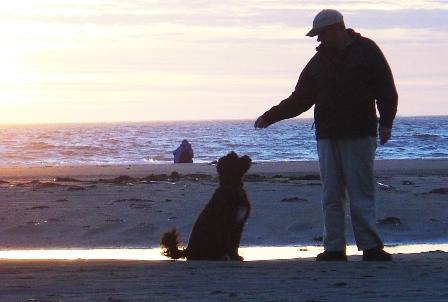 Sarah was one of those pawrents. She and her 5 year old Portuguese water dog, Jake, recently came to us through Tazzie, a mutual friend in Canada. Sarah posted in the forums, looking for advice when Jake's spinal bone cancer became dramatically worse.
She and Jake had walked a long road up to the bone cancer diagnosis. His behaviors exhibited possible diagnoses ranging from a ruptured disc to arthritis. When cancer was finally discovered, Jake wasn't an amputation candidate because the cancer (later inconclusively diagnosed as chondrosarcoma) was in his spine.
Sarah found little information online about bone cancer in the spine, and unfortunately we too made the same discovery. Sadly, in just eight weeks, Jake's health rapidly declined and the intense pain was too much to bear. After a bone biopsy was taken, he could hardly walk and suffered from bouts of intense pain. Sarah released him from his pain on December 12th, just two days later.
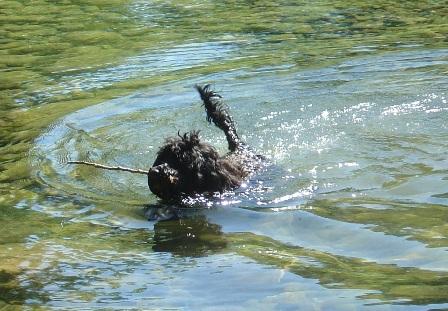 Afterward, Sarah told us that she was completely unprepared for the way in which bone cancer in the spine presents itself in dogs. It was distressing not to find even an ounce of hope or ways to cope.
But Jake's death will not be in vain. Sarah wrote the following summary of her experience, to help anyone else who might find themselves with a dog suspected of having spinal bone cancer. We are grateful for the time she took to help others in this way.
Please read on to learn about the symptoms, behaviors and progression of this devastating presentation of bone cancer.
Swim on, Jake, you will never be forgotten . . .
Primary Chondrosarcoma of the spine – Jake’s Story
by Sarah Crook
Written in the hope that reading it you will be more prepared to cope with this awful disease than I was. The progress of the disease from no symptoms to death took 8 weeks. The cancer was located in the C7 vertebra (lower neck).
Early signs (first two weeks):
- A stiffness that developed after 15 to 20 minutes walking. Jake woke up in the morning seemingly fine – the stiffness was only obvious with exercise and occurred even with moderate exercise, like leash walking. Round the house Jake’s activity seemed normal and the stiffness was not apparent (this pattern seems unlike what I have read about arthritis where the dog wakes stiff, then it gradually wears off).
- A reluctance to go up/downhill that I noticed when walking Jake off-leash. Jake still followed but lagged behind.
- A cautious approach to going up/down stairs especially after a walk when he had stiffened up
- Cautious approach to getting in and out of car – fairly subtle. Just a hesitation before jumping and a preference to climb in rather than jump..
- A reluctance to stretch his head down to eat or drink. Backed off and barked at his food bowl until I raised it up.
- Very subtle – I only thought of this in retrospect – sometimes a slight unsteadiness when he cocked his leg for a pee.
Middle period (middle four weeks):
- After 2 weeks Jake was seen by a vet who physically examined him and found stiffness in his neck and a reaction (growl/snap) when upper back was pressed hard. Soft tissue injury was suspected and Jake put on Metacam and restricted exercise.
- On Metacam he seemed livelier around the house and more playful – but the stiffness and stiff-legged gait still continued when exercised and as things progressed, would start after only 5mins. A video clip taken at this time shows his normal walk when setting out, then the stiff-legged ‘walking on eggshells’ gait that he would suddenly adopt; and his cautious approach to going down a step.
- After 14 days of Metacam and no obvious improvement, Jake was put on Robaxin – a muscle relaxant. Robaxin made him much WORSE. He was clearly uncomfortable in the house – standing looking miserable, seemingly afraid of sitting or lying down (as if he thought it would hurt – which it probably did). His back legs became noticeably weak and he hard difficulty climbing upstairs (ataxia). I was especially aware of him being restless through the night (prior to this he slept well) – he would sleep for a few hours then wake apparently in discomfort and take 5 or 10 minutes to lever himself up and settle into a new position. Later, I found out from the oncologist that this was not unexpected – Jake’s muscles would have been protecting the painful part of his spine, and with the muscle relaxant they could no longer do this.
- After 5 days took him off Robaxin and the vet put him back on Metacam. Ataxia lessened, slept well again, things seemed to improve – but in retrospect he did not recover to pre-Robaxin level. Jake started doing ‘girlie’ pees and if he tried to cock his leg consistently lost his balance. I later learned the weakness in his back legs and the uncoordinated gait (‘ataxia’) that developed were the result of the tumour and/or associated inflamed tissue compressing the spinal cord.
End Phase (last two weeks):
- Increasing unsteadiness of back legs so took Jake once more back to his vet. Same stiffness in neck and sore place on upper back. Blood samples were taken to rule out the slight chance of a tick born disease and vet referred Jake to a surgical specialist and a neurologist.
- Surgeon examined Jake and suspected ruptured disc – recommended MRI.
- Neurologist examined Jake and suspected lesion in lower neck and upper back (either two separate ones or one big one) Recommended CAT scan.
- Cat scan showed tumour in C7 vertebra about 2x2cm in size, and a biopsy was taken. I met with an oncologist and decided to have one radiation treatment to see if it would reduce the pain and inflammation. If not, I would have him put to sleep.
Last Two Days:
 Jake came home on a Thursday afternoon after having the CAT scan and bone biopsy the previous night. He was on Perkocet but a couple of hours after getting home had a bout of severe pain – later I thought this episode must be similar to ‘breakthrough’ pain suffered by human cancer victims.
He had two more of these attacks on Friday night and then early Saturday morning, in spite of having started on stronger pain relief (morphine and Gabapentin – and more Metacam, although he deteriorated so fast I never got around to adding this to the cocktail) and they all followed the same pattern – 5 to 10 minutes of increasingly fast panting, signs of acute pain (groaning and struggling to his feet to stand hunched over, head hanging, tongue lolling) lasting 10 – 15 minutes; 20 – 40 minutes of gradually winding down (I could get him to sit on my lap and would rub him and try to calm him). On Saturday I decided enough was enough, it was too late to try radiation therapy, and I had him put to sleep that afternoon…
In retrospect
- I am not sure if I wish I had asked for an X-ray early on and found the tumor sooner. Early diagnosis would have meant when he could still run around I would not have been limiting his exercise and keeping him on-leash all the time… and there would have been time to plan treatment such as radiation therapy. However, the bone biopsy would also have been done sooner and maybe even early on the consequences (huge increase in pain and decrease in mobility) would have been the same as below – see next point.
- I would not have had the bone biopsy done without much more careful consideration – I blame this for the rapid deterioration in Jake’s condition at the end – hugely increasing the pain and causing increased inflammation that severely impacted his mobility and comfort level: he could hardly walk when he came home his back-end was so uncoordinated and weak.
- I would have asked the oncologist for pain meds. to deal with the ‘breakthrough’ pain (if indeed that was what it was). If there aren’t any effective drugs to deal with it, I would have at least discussed what I could/should do if these attacks happened.
- I would have had the consulting oncologist leave a prescription for stronger pain medication with an 24hr animal clinic in case Jake suddenly got worse in the night or at the weekend when she could not be contacted.
- I would have got the contact details of a call-out vet who could come and put Jake to sleep when Jake’s own vet clinic was closed….
 Jake’s own vet and the specialists he referred me to were consistently caring and conscientious. Both contacted me this week after I wrote to them raising some of the issues I mention above. They spent nearly an hour going through things with me, so I think they deserve credit for this, especially my vet, as he must have known the length of time in getting to a diagnosis would be a tricky subject to discuss.
Not a happy end to a bright and loving creature. If you are facing the same I know reading the above will be distressing – but I hope it will help you make the right choices for your pet.
Best wishes, Sarah
Tripawds Founders Jim and Rene
tripawds.com | tripawds.org | bemoredog.net | triday.pet

I can relate to Sarah's distress. When Emily's cancer spread to her spine I was totally unprepared for it. I thought we would get a lung mets diagnosis and have to decide what we were going to do. Instead we battled what we thought were injuries and then hip dysplasia. When the cancer is in the spine there are no choices. Pain can not be controlled. The only thing you can do is let your dog go and release him/her from the pain. It breaks my heart to read that mets to the spine are so common. I had no idea and none of the vets talked about it, just about lung mets. We let Emily be in so much pain for weeks thinking it was dysplasia. If I had it to do over I would request x-rays further up the spine. Yes, we would have lost her sooner but we would have spared her a lot of pain,
Debra & Angel Emily
Debra & Emily, a five year old doberman mix, who was diagnosed with an osteosaecoma. She had a right rear leg amputation on May 19, 2009. On November 10, 2009 she earned her wings and regained her fourth leg.
Debra, thank you for sharing your heartbreaking experience here. When I was diagnosed, my pawrents weren't told about this either. Thanks to you and Sarah, more people will be aware of what might happen with spinal mets and be able to get a better diagnosis for their pup.
Please don't be so hard on yourself about not knowing what it was. Emily knows you did all you could for her with the information you were given. You are an awesome dog Mom.
Tripawds Founders Jim and Rene
tripawds.com | tripawds.org | bemoredog.net | triday.pet


This an excellent review of symptoms and diagnosis of spinal pain/tumors. It must have been very hard to post this so soon after losing your sweet young dog. I can only reiterate what Emily's mom said about spinal mets; they are very painful and the prognosis is poor. It is too bad that spinal mets can mimic other orthopedic disease and they are so hard to find radiographically.
Pam


It is very hard for me to read just now about Raven, and now Jake's story, to have myself re-lived the final three days of Genie's life. I share Sarah's pain, and admire her courage to document all the details.
From what I have heard so far, no vets mentioned to any of the pawrents about spine mets, and the symptoms.
This is my coulda/shoulda/woulda… Had I known that spine mets "exist" at all (that was completely me being naive andmy ignorance), I would have thrown in the towel three days sooner and sent my baby to Heaven when the drastic deterioration started. I didn't know what was going on, and I thought still it was spondylosis causing her mobility problems. I could have ended her suffering 3 days sooner, but I didn't. People might say I should not be beating myself up, but the fact is I did let that happen, and that is going to haunt me for the rest of my life.
I am glad that the Tripawds community are becoming more aware of symptoms of spine mets, future pawrents will get the information here if not from the vets. The sad part is that the more stats we could gather, the more dogs had gone down this path.
tazziedog said:
This an excellent review of symptoms and diagnosis of spinal pain/tumors.
Thank you so much Pam, this means a lot to us knowing that it's coming from you, not just because of your background but because you have unfortunately been through it too.
Jessie, please don't be so hard on yourself. We can only take action when we have information available to us. You did everything right, above and beyond what most people do. Everything you did you did for Genie's sake, she would never, ever hold your decisions against you.
I hope that whatever stats we accumulate here will someday lead to the eradication of this horrible disease. We have to hope.
Tripawds Founders Jim and Rene
tripawds.com | tripawds.org | bemoredog.net | triday.pet

One thing that comes through Sarah's post, conversations with her last fall when Jake's condition was not yet diagnosed correctly, plus many of our own experiences is the need for vets to consider the possibility of cancer when a limp does not clear up quickly. I think "oncovet" stressed that point in the chat session - if a dog's limp does not clear up, vets should take x-rays or send them to a specialist. Unfortunately, we only learn that point after we end up on this site with a diagnosis. That is one message I wish could reach beyond our community.
I don't want people to be paranoid. But I think as a dog-owner, especially when a dog of a certain size is involved, we should be aware of that so we take a dog to the vet if it does have a limp that does not clear up. (I was so accustomed to managing periodic lameness in my last dog, who lived to 16 yr, that I did not act quickly in Tazzie's case.) From people's accounts on this site, it seems that many vets should also keep this in mind so they could act sooner by taking x-rays or appropriate scans early. I remember Angle Moose's parents saying that their vet had a nice discussion with them when Moose was a pup in which they mentioned this as one condition that Danes were susceptible to. As a result, they were quick to take Moose to the vet for an x-ray when he developed a limp.
Jessie, I feel your pain. And I think we do need to not be hard on ourselves. Spinal mets mimic so many other things. Even my vet thought it was hip dysplasia because xrays showed dysplasia but no sign of spinal mets. When Emily did not respond to treatments she became very concerned and called OSU where Emily had been treated for her cancer. I regret the time that Emily was in pain but I still know that what we did was for her. My vet worked with the information she had. We worked with the information we had. Everything we did has for Emily. You worked with the information you had. Everything you did was for Genie. Everything. Please allow yourself to accept that.
I love that this web site provides not only comfort and support for each other but also provides information and education. Newbies to the site know more because of the tripawd angels that have gone before them. Genie and Emily and Jake and Tazzie and so many others who have suffered spine mets are important for people to be aware of. Vets included. I think cancer is the kind of desease that varies so much it has to be hard for even vets to be on top of it.
Our personal vets may only see a hand full of cases of cancer in their practice. Most are then sent to specialists. I think they don't mention spinal mets because they don't really see it that often. I don't have any bad feelings for my vet for her not knowing it was spinal mets so I don't allow myself to have bad feeling about me either. (For the most part, that is. I have to push those feelings away as they appear!)
I know this post varied from the topic but I really felt the need to respond to Jessie. I did not PM because it is important that new people see not only what happens to our dogs when they get cancer but to understand what we go through and our reactions to it. Guilt, unfortunately, is a normal reaction. When I feel guilty I ask myself what I would tell someone on tripawds if they posted my feelings and then I try to accept my own advice.
Debra & Angel Emily
Debra & Emily, a five year old doberman mix, who was diagnosed with an osteosaecoma. She had a right rear leg amputation on May 19, 2009. On November 10, 2009 she earned her wings and regained her fourth leg.

I want to thank Sarah for doing such a wonderful job documenting and explaining what went on for she and Jake, and Jessie and Debra for responding so candidly about their feelings. It is something none of us wish to think about, but something some of us are going to face. I'd rather know what other folks have experienced and know what the possibilities can be rather than being blind sided as I was with the original diagnosis. You guys have proven once again what exceptional individuals we have contributing here. My greatest hope is that one day you will be at peace with the decisions you made. We can only decide based on the information we have at that point in time. You all did an awesome job with the challenges you faced.
We are truly blessed to have this outlet where we meet and share such painful experiences and some of the greatest joys. Thank you all for your honest and heartfelt opinions.
 Shanna & Spirit Trouble ~ Trouble gained her wings 3/16/2011, a 27 1/2 month cancer survivor, tail wagging. RIP sweetheart, you are my heart and soul. Run free at Rainbow Bridge.
The November Five - Spirits Max, Cherry, Tika, Trouble & Nova. 11/2008 - 3/2013 An era ends as Queen Nova crossed the Bridge.
Thank you eveyone for the kind words. I did not mean to hijack Sarah and Jake's story.
I totally agree with Sarah's "In Retropect". Putting my guilt aside, what I would have done similary in retrospect...
- I would have requested for a bone scan, MRI, which would show spinal mets, bone mets better than x-ray. We did x-rays on her hind legs, hips, lumbar spine, but no signs of mets. May this procedures very soon will become more accessible, and economical.
- Had I got spinal mets dx confirmed, or at least known of the symptoms, I would not have believed what the vet had suggested, Urinary Tract Infection, when Genie started dripping, leaving wet spots here and there.
- I would have taken her to the emergency vet clinic on the Saturday. I was still holding hope that after the long weekend, the scheduled Tuesday appointment for acupuncture treatment would help. We had endured a full blast of all the "what-I-know-now" symptoms of spinal mets over the long weekend; and by Tuesday, it had become very clear that the supposedly scheduled elective appointment with the vet had turned into an emergency last visit. By then, whether or not it was spinal mets, was not important anymore.
- I would have spoiled her with all my might, and the heck with all the pills popping, and all the house rules.
Apart from the intermittent feeling of guilt which I know deep down in my heart is plain silly, to be honest, I am glad that I was "awake" enough to make the call, instead of dreaming that a couple of more acupuncture sessions, or prednisone, or radiation therapy, could reverse the irreversible.
Thank you Sarah, Jake for sharing your experience. My thoughts and prayers are with you.

Thanks everyone for your kind words – though really it was not brave of me to write this account of Jake’s end at all. It was a relief. It all happened so fast and was such a shock, writing it down helped me understand in some way what had happened… I am hugely grateful to the Tripawd website for being given the opportunity to share Jake’s story.
Reading the responses did make me think of one thing that I didn’t include in Jake’s story. Something that might be of use to those of you who are wondering if some new symptom could be the result of the spread of cancer to the spine, but maybe don’t want to put your dog through another general anaesthetic and MRI – and maybe too have to think about the cost. Jake’s tumour was in fact initially diagnosed by a neurologist, by a very simple non-invasive testing of his reflexes… and (just?) watching him walk around. The reflex testing was done with a little hammer (like with humans) for the joints, and by pinching (lightly) certain spots over his flanks. The whole careful, meticulous examination took about an hour and cost $165. Of course not everyone will have access to a neurologist – but if one was available and you were worried about a symptom that possibly could be neurological and caused by spinal mets, this might be something to consider.
Another point raised by this same neurologist when I asked him why he didn’t just wait for the results of the MRI (at the time of the examination Jake was scheduled for one that evening) was that imaging techniques can give too much information: that there are often abnormalities picked up that have nothing to do with the problem under investigation… He preferred to make his initial diagnosis then use the imaging to confirm and lend detail to this diagnosis – in Jake’s case the exact location and size of the tumour and (with the bone biopsy) the likely type of cancer. But is this detail worth obtaining if you are planning only palliative care...?
And – so sorry to have awakened sad memories for Emily- and Genie-moms. It is awful watching an animal you love suffer. Although holding Jake through his pain, knowing he wanted me there by him, being totally absorbed in one thing together, brought a closeness hard to describe. Looking back I see it as a rare gift, that two separate beings, different species even, can somehow find in such extremity complete understanding at last.
SpiritJakesMom
sarah said:
Jake’s tumour was in fact initially diagnosed by a neurologist, by a very simple non-invasive testing of his reflexes… and (just?) watching him walk around.
Sarah, that is more pawesome advice, thanks. It helped my pawrents to recall that when I was undergoing my first round of diagnostic tests at UC Davis, before my amputation, the orthopedic surgeon did the same simple test on me too. Thanks for helping us remember that.
Tripawds Founders Jim and Rene
tripawds.com | tripawds.org | bemoredog.net | triday.pet

Wow, it is just amazing to read these posts.
We lost Killer two weeks ago today. I still cry of course, mostly in the mornings driving to work and when I first get home in the evening--perhaps my most vulnerable times. But I also think back over the terrible month of January, when her walking problems started, and try to figure things out in retrospect. Nothing will change of course, Killer will still be gone, and the hole in my heart will still be there. But eventually we all fall in love with another dog, or we wouldn't be who we are. You know, "we who chose to surround ourselves with lives even more temporary than our own live within a fragile circle, easily and often breached...we still would live no other way." So the more you know the better off you and your dog are.
The reason for my rathter verbose post is that I am starting to believe that Killer did have cancer in her spine rather than the hip dysplasia (which she did have) being the prime cause of everything. The symptoms, not being able to walk, crying and staying awake in spite of being maxed out on tramadol and remadyl, the loss of bladder control...My regret is having only xrays done by the regular vet, not having CT or MRI done. The xrays cost me $688, I could have afforded a little more and found out for sure. Here is where pushing the vets or overruling them might be necessary sometimes. I love the vets who treated Killer, but the oncologist dissauded me from getting the bone scan with all the time, effort, and putting the dog through so much. And the regular vet (although she wrote in the notes that she had discussed getting a bone scan at the specialist, she did no such thing) assured me that the xrays were extensitve and they could tell things from them. Well my point isn't to beat up on the vets, but to point out to folks still going through this--push those vets sometimes, get even another opinion, or check out the posts in these forums and the wisdom of people who have already gone through this. I am sorry for Jake and his family, and for all the dogs who have been lost recently, seems like so many.
I hope that peace will come to all of them, as I'm waiting for peace to come to me.
It seems if all the posts in response to this topic are much the same and I have that to be the unfortunate truth about osteo/chondrosarcoma of the spine. Today I put my beautiful 6.5 year old Weimaraner, Sage, to sleep. Her story is much like others here and unfortunately even more extensive. Here is Sage's story as I'm using it as a way to cope with the loss of my best friend.
Last Friday afternoon my mother-in-law mentioned to me that she thought that Sage was moving "a little slow" and asked if she had a hectic day the day prior. I simply responded no, I didn't think so, and called Sage over to me. I saw no visual abnormality in her gait as she walked across the kitchen and she responded immediately so I didn't give it a second thought. The next morning we immediately noticed that Sage was walking with an awkward gait and what appeared to be stiff hip and knee joints. It was almost as if Sage was wallking on egg shells. We decided to treat Sage with a couple of baby aspiren, twice that day, per our vets orders. Sunday we awoke to a similar situation and after a short nap on Sunday early afternoon with my daughter, I awoke to Sage being unable to walk on her hind legs. THATS HOW FAST IT HAPPENED! Less than 48 hours from an active dog who was running through the backwoods and fetching birds to being confused and immobile.
That Sunday, upon finding Sage in her condition and unable to walk, I immediately took her to Madison, WI and Veternarian Emergency Services (VES). At VES she was immediately diagnosed with a ruptured disk based on various special testing (reflexes/vet examination/etc...). Sage and I were immediately referred to VES west side clinic as they had an orthopaedic veternarian surgeon on call that evening. We arrived at the west location 15 minutes later and the orthopaedic immediately reviewed the various possibilities that Sage's pain could be resulting from various conditions which included ruptured disk, tumor (benign or malignant), infection, or meningitis. The surgeon was very thorough however strongly believed that a ruptured disk was what we were dealing with and decided to proceed with a myelogram (X-ray with injection). If the myelogram was positive and showed a herniated/ruptured disc, a hemi-laminectomy of the vetebrae would be the next step. I had to leave Sage at the vet that evening and was under the assumption that three hours later I would get a call from the vet stating that the surgery had been performed and all went well. I was so very wrong...
An hour after I had arrived home from Madison, I received a phone call from the orthopaedic vet... He explained that Sage's myelogram came back and did not look typical of a simple ruptured disk and rather it showed a small herniation in the L2-L3 area, as well as a great deal of inflammation above the lower thoracic region just above the L2-L3 level. The surgeon wished to abort the surgery until he could send the lab and myelogram results to the University of Wisconsin Madison Veternarian School and Clinic for a neurologist to review and add clarity to. Our orthopaedic was undecided as to what course of action should be taken next and felt that an MRI may be necessary to further diagnose.
The next day while I was at the clinic visiting Sage with my parents we received word back from the Neurologist at UW that it was her recommendation to forego an MRI and to perform the hemi-laminectomy. She felt that the suspected herniation at the L2-L3 level was the root of the problem and the surgery was necessary to return function of Sage's lower limbs. Sage's symptoms had worsened slightly over the course of 20 hours and had lost neurologic signs down both hind legs (no sensation to pain/pressure).
We were overjoyed with the Neurologist's assesment of the myelogram and felt that this was the news that we were looking for. At this point Sage was beside herself with anxiety and it was time to take action in one form or another. We felt so fortunate that our next course of action was potentially going to rid Sage of her paralysis and her symptoms. For those of you who are unaware, dogs who undergo a disc laminectomy have a 90% chance for full recovery even when paralyisis is reached within the hind legs. We thought 90% was great and according to the orthopaedic, if the surgery went well, Sage would likely be home within 48 hours.
We left Sage that night and gave her our hugs and kisses goodbye. I prayed that I would not receive a quick phone call from the surgeon as I did the night before, and this time my prayers were answered! Three hours later I received a phone call from the surgeon who stated he was "pleasantly surprised" with Sage's surgery. He stated that he removed the disk and was surprised with how DESTROYED the disk actually was. He described the disk as being in fragments and this was unusual given that the disk should be only torn or in a couple of pieces. Regardless both the surgeon and I were happy with the outcome and now it was only a matter of time before her neurological function and mobility returned...
We visited Sage the following evening and she was in good spirits... Eating, drinking, kissing, and not in a great deal of post surgical discomfort. We thought all was well and the orthopaedic told us to prepare to take her home the following day. Our journey was almost over... Unfortunately it was all but over.
We picked Sage up the following evening and she was discharged from VES. We decided that she should rehabilitate at my parents home as this is her second home and my mother was able to give her 24 hour care and love. It was a perfect situation for Sage... She was going to get spoiled rotten!
That brings us to yesterday... Thursday. If you remember correctly, I originally stated that Sage's symptoms first showed on the previous Friday. On my way home from work on Thursday I received an unexpected phone call from Sage's orthopaedic vet. He asked how Sage's progress was going and I was proud to report that Sage had a return of bladder function, a return of neurological pain symptoms, was eating well, and as far as we were concerned was doing better. There was a brief pause and I wasn't prepared how the next 30 seconds would change my life forever. He explained that although these signs were encouraging, he had some very bad news for Sage and I. He went onto explain that he just received Sage's pathology reports and they had come back positive for chondrosarcoma (cartillage cancer). He went onto explain that this was why Sage's disc had been so fragemented upon removing it (cancer had destroyed it). He then told me how poor the prognosis was with a diagnosis of chondrosarcoma and for the first time stated that it was time to begin deciding what quality of life Sage had in store for her.
That night I drove up to my parents house as I needed to be with Sage. When I spoke to my parents I heard her moan and groan over the phone. I think some of this was due to anxiety and some was due to the pain that so many of you had described in your posts. I was able to spend last night with Sage in front of the fire in the living room. We were curled up on down comforters and pillows and I had her in my arms all night. I think we both knew what was in store for us the next day. As her neurological function returned, the pain from the cancer would gain intensity and she would soon be in horrible pain. The next morning I awoke to some subtle whining and crying, nothing significant, but I know my Sagey and I knew her pain was slowly increasing. This is when I made my decision with the help of my wife, mother, and father. The cancer had taken my little girl's ability to run, jump, and even feel, but I'll be DAMNED if that cancer was going to put her through any more pain than what it put her through thus far.
It was only 12 hours ago that I found THIS unbelievable website with unbelievable personal stories of beautiful dogs who have gone through the same situation that Sage was going through. I want to thank all of you for sharing your stories and giving me the insight to put my baby to sleep and to send her to the angels. I will see my little girl again someday... And when I do she'll be cancer free and all will be good. If this story helps only one person and their dog, then Sage did not pass without reason.
God Bless and Good Luck To All Of You
Dave Rezin
Dave
Thank you for posting the story of Sage. I am so sorry you had to go through this and now are suffering her loss. It is amazing you could write this story now, but it will be certain to help many others. It sounds like you and your family had a wonderful life with Sage. I hope you find some comfort from family and friends at this difficult time.
Susan


1 Guest(s)
