If your dog or cat has osteosarcoma, are you trying to decide if amputation is the right path forward? Today on Tripawd Talk Radio #136 you’ll learn how to decide on next steps and treatment options.
Our teacher is the pawesome veterinary surgical oncologist Dr. Deanna Worley from the Colorado State University Flint Animal Cancer Center!
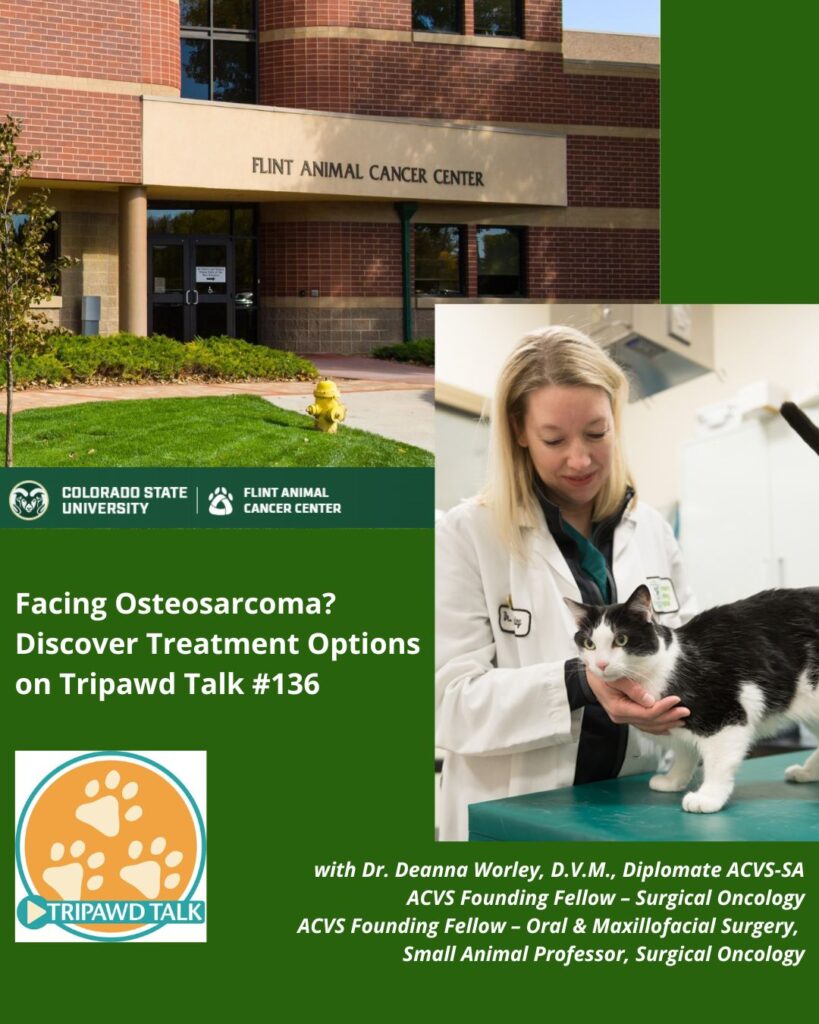
Dr. Worley Gives a Surgical Oncologist Perspective on Current Osteosarcoma Treatment Options and Amputation Decision-making
In this episode we discuss how to know if amputation is right for your cat or dog. We also explore amputation alternative treatments.
Plus,Dr. Worley helps us make informed, compassionate osteosarcoma treatment decisions that prioritize a pet’s quality of life, and our own.
What You Will Learn in This Episode
There is rarely a need to make a same-day decision. Families usually have time to gather information and reflect.
Quality of life goals, emotional capacity, finances, and physical ability all matter in choosing the right treatment path.
Advances in limb-sparing surgery, radiation therapy, and pain control offer more options and better recovery experiences than ever before.
Ready to discover how you can make the best choice for your dog or cat with osteosarcoma? Download the podcast below, watch here on YouTube, or get into the details with the transcript that follows!
Tripawd Talk #136: Facing Osteosarcoma: Treatment Options for Tripawds
Subscribe to Tripawd Talk Radio in your podcast player app!
Tripawd Talk Radio Podcast #136 on YouTube, with Dr. Deanna Worley
About Dr. Deanna Worley DVM, Diplomate ACVS-SA
Dr. Worley is a Professor of Surgical Oncology at the Colorado State University Flint Animal Cancer Center and an ACVS Founding Fellow in both Surgical Oncology and Oral and Maxillofacial Surgery (Small Animal).
Her work focuses on advancing cancer surgery through innovative techniques that reduce surgical trauma, improve outcomes, and investigate lymphatic metastasis and targeted therapies.
A Montana native, she earned her bachelor’s degree in biomedical science from Montana State University and her veterinary degree from Colorado State University, followed by advanced surgical training that included internships in Dallas and Houston, a small animal surgery residency at the University of Pennsylvania, and a surgical oncology fellowship at CSU.
Dr. Worley is deeply committed to compassionate, quality-of-life-centered cancer care, collaborative research, and training the next generation of veterinary surgeons.
Resources Mentioned in this Podcast
- CSU Flint Animal Cancer Care Center
- The Veterinary Cancer Society webpage
- 3D-Printed Implant Study for Limb Sparing
- Cementoplasty as an Amputation Alternative
- New Limb Sparing Surgery for Dogs Makes It More Accessible, Potentially Less Risky
- Tripawds Support Circle
TRANSCRIPT: Tripawd Talk #136
Facing Osteosarcoma: Treatment Options for Tripawds
Introduction
TRIPAWDS: All right, Dr. Worley, thank you so much for being here today.
DR. WORLEY: Thanks. It’s a pleasure to be here.
TRIPAWDS: We’re so happy to have you because this topic about dogs and cats who might not be considered the greatest amputation candidates are a big worry for pet parents who are trying to decide should I, shouldn’t I? My dog is older, or my dog has some chronic issues and you’ve got this shadow of cancer looming in the background and you’re not quite sure what you should do.
So, I was hoping that we could talk about dogs and cats and how you might approach the conversation differently when cancer is involved and the possibility of amputation or possibly an alternative to amputation.
Evaluating Amputation Candidates: What Gives a Surgeon Pause
DR. WORLEY: Yeah, that’s a great question and I recognize that being confronted with a treatment option of limb amputation can feel like standing in front of a Mac truck heading at you at 80 miles an hour. And it can be quite jarring to have that be presented as one of the options on the table for cancer care and or for any type of treatment option honestly since it is such an irreversible decision.
How I approach limb amputation for candidates that are not perfect is I kind of share what the pros and cons are.
Things that I’ve learned over time is that:
- Animals that are morbidly obese (not just overweight but morbidly obese) give me pause.
- Animals that have wobbliness from neurologic disease where they’re just a little bit wobbly give me pause. Anything more than that where they’re knuckling over or falling over, that definitely is a kind of a deal breaker for me.
But I wouldn’t say no to an animal that has just a mild wobbliness; that’s not a deal breaker, but it is a concern to share.
- Sometimes conformation can be a point of pause or concern but not necessarily for amputation. For instance, some animals that have a really long spine and short legs; however, I’ve had several Basset Hounds and Dachshunds prove me wrong that do great.
- The other scary thing is that when you’re in a vulnerable situation asking a medical professional for advice, what you want to hear is a guarantee that everything’s going to be okay and whatever options are presented will be perfect.
As a medical professional, that’s so frightening because we can’t predict how things are going to go. We can counsel and we know what risk factors are, but we are not in control of biological systems.
You never know what’s really going to happen, so we do our very best with providing counsel.
Cats as Amputation Candidates: What Makes Them Different
DR. WORLEY: Going back to the kitty cat, cats are different than dogs. Cats tend to be very darn motivated. They’re phenomenal creatures and they are so motivated and stubborn. I honestly think cats are more intelligent than dogs. I mean, I love dogs, but there’s also a higher reasoning that cats have.
What’s interesting is they found that cats have fewer muscles in their face, so it’s harder to understand their facial emotions. It’s more subtle, whereas dogs have a greater number of muscles in the face, so it’s a little bit easier to see what they’re feeling.
Cats are much more subtle, and I find it interesting that they may be even more emotionally complex than dogs, but it’s just harder for us to perceive because of those fewer muscles.
Cats are very motivated to get things done.
I tend not to exercise restrict a cat when they’re having surgery. I may recommend a smaller space and putting obstacles on things that they think they want to be on, like if they need to be on that window ledge, put a big box on it so they see that they can’t really do that.
But they’re pretty darn motivated. That doesn’t mean they don’t feel pain, and we work very hard on managing pain.
For an overweight cat, I would counsel that the healing time might take a little bit longer and the outcome might be slightly more uncertain.
But when I look at the goals of the procedure: is it going to provide better quality of life? Is it a treatment option that is less resource-intense for the family? Is it more inexpensive and allows them to move forward or get the animal back home?
If the goals outweigh the risk to me, then that procedure meets the goals to move forward with the limb amputation.
Setting Goals and Making Decisions as a Family
TRIPAWDS: That’s a really good way to look at it. So, maybe we study our animal for a day and watch what they do.
- Write down goals, like “I want my cat to be able to get into their favorite spot” or “I want my dog to be able to go this far on a walk”.
- Jot those goals down and then consult with their veterinarian to find out if the surgery is going to take that away or how much it could take away.
Is that what I’m hearing you say?
DR. WORLEY: Yes. And I would actually take it a couple steps further. I think it also goes into what is the emotional capacity of the family to handle bumps in the road like complications.
Is the stress of facing a complication going to be so debilitating that maybe that option isn’t the right one?
Sometimes I’ll have clients project themselves five years in the future and look backwards at what they would regret most about making a decision.
For a lot of clients, they put pressure on themselves for making the best decision. I like to flip it and say, “What would be the worst outcome for you? What would give you the greatest regret in life?”
Then take that off the table and it flips the decision-making and decreases the stress.
Financial Reality and the Role It Plays in Decision-Making
DR. WORLEY: The other thing that I think is really important is your financial capability. Where your financial capability is at one point in time is going to be different in another point in time.
When you make these decisions, you shouldn’t have to feel like, “If I was five years later with more money, I would make the decision there.” It’s okay that whatever decision we make is faced with the reality of where we’re at at that point in time.
For instance, if you think your Irish Wolfhound might need assistance getting in and out of a car and you’ve had your own surgery, then maybe a procedure where you have to be physically present for your dog isn’t the right answer at that point in time.
If you have an animal that’s going to require medication four times a day but you have a 12-hour job and you don’t have the resource of time, maybe it’s okay to have a decision-making process that requires things that are less labor and time-intense for the family.
There’s a lot of different things that should be taken into account and they’re all valid.
What you decide at one point may be different tomorrow or in two months, and that’s okay. That still means the decision you made today was the correct one for that point in time.
TRIPAWDS: That is so wise. I love what I’m hearing you say because we tend to put our own needs way below the needs or our perceived needs of our pets.
Everybody beats themselves up because they don’t have the money they want to do what they feel is best for their animal. So you’re right; look at the whole picture and what we need.
We see quite a few people in our community who struggle with the recovery part because they have a back problem and are unable to assist their dog getting up the day after surgery. I like that it doesn’t mean we’re being unfair to our pet; it just means we’re taking the whole picture in because they’re such a huge part of our lives.
Letting Go of Guilt When You Choose Not to Elect an Option
DR. WORLEY: I’m going to say real quick, too, that even when a family decides they can’t elect an option, they’re still doing something for their pet.
There’s a lot of guilt when people don’t elect one of the options we present. I remember when I was a surgery resident in Philly and I had an income of $22,000 to $23,000 a year. I couldn’t afford more than a roof on the house, food on the table, and a secure environment. That was all I could provide, but I was still providing them love and care.
I was still meeting needs even though they may not be higher-level needs.
Clients shouldn’t feel guilty when they choose not to elect options because they’re still providing care, nourishment, and emotional nurturing at home. It’s still valid.
Limb-Sparing Surgery: Then and Now
TRIPAWDS: I think we tend to forget that veterinarians have had financial challenges as students, too.
Let’s say that somebody does have a dog or a cat—I don’t know if limb-sparing surgeries have been done on cats—but they want to pursue a treatment that isn’t amputation.
Can you give us an overview of what limb-sparing was 20 years ago versus where it’s headed now?
DR. WORLEY: Limb-sparing to me is any type of procedure that preserves some kind of functional use or physical presence of a limb.
It depends on where a tumor is located and what can be salvageable so that a leg is still viable. That doesn’t mean the leg may work perfectly normally or like it did beforehand.
- For instance, we have tumors on the pelvis at certain locations that we could take off but still save the hind legs.
- Tumors on the ischium and even on the ilium can still be limb-preserving procedures.
- We can have tumors of the ulna, which is another bone next to the radius on the front leg; we can take two-thirds of that bone off and have a leg that’s still completely functional because 80% of weight-bearing occurs on the radius.
- You can’t disrupt the elbow joint to have a limb that’s preserved. We can take 100% of the scapula (the shoulder blade) and have an animal walk on their leg without a scapula, though that takes a fair bit of rehabilitation.
There have been reports of tumors being removed and bones being put back together intentionally short to have a leg that still works.
The old adage was you can take about 20% of the leg length and not have a noticeable gait abnormality, but colleagues in the field have challenged that.
You can take a greater amount of bone and still have a leg that is usable, even though it’s significantly shorter and there would be a mechanical lameness.
We’ve had poor success with the top of the humerus (the long bone into the shoulder joint); biomechanically those have failed because the implants are either too strong or not strong enough.
There are some “unicorn” cases where the tops of the femur (the hip joint) have been removed and replaced with an artificial joint and a very long stem to recreate a portion of the femur.
We’ve also done things in a more palliative manner where we treat a tumor, leave it in place, and put a plate on it, but we have lots of challenges with those.
The future of limb-sparing is going toward going after metastatic lesions on multiple areas of the body and preserving them by boring them out and putting in cement or some kind of stabilization to improve the strength of the bone the tumor is chewing up.
We are lagging behind in veterinary medicine with that due to equipment and skill set challenges, but that is the future.
TRIPAWDS: Is that the procedure known as cementoplasty?
DR. WORLEY: It is.
A New Clinical Trial: 3D-Printed Bioresorbable Implants
TRIPAWDS: Interesting. So, are all of these examples of limb-sparing for animals that had cancer?
DR. WORLEY: Yes. Classically, limb-sparing in the veterinary world refers to a tumor of the radius, the lower part of the front leg right above the wrist joint.
Basically, it’s either cutting that bone out and replacing it with cadaver bone, a metal spacer, or other implants.
We have a new clinical trial enrolling giant breed dogs where we remove the tumor’s bone and insert a 3D-printed bioresorbable construct with a plate.
The goal is to stimulate new bone growth. Instead of using cadaver bone or a metal spacer, we’re using a 3D-printed structure that hopefully might grow bone so we don’t have as many challenges with infection down the road.
This trial is funded through the Morris Animal Foundation and the requirements are a tumor in the lower radius, no evidence of metastasis elsewhere, and being a giant breed dog.
TRIPAWDS: Wow, that is so exciting. Now, you’re saying that these parts will go into the body and then just get reabsorbed over time?
DR. WORLEY: Eventually. We don’t fully know how it will work in the dog yet. This is an evolution of work by Dr. Bernard Seguin on personalized 3D-printed implants. The “holy grail” would be that the animal is able to regenerate bone and not have to have an implant.
TRIPAWDS: That is cool. I assume that the dogs that participate would have to live in the area?
DR. WORLEY: Initially, it would be ideal to have someone near for a period of time. I also want to give credit to Dr. Bernard Seguin, Dr. David Prowell, and Dr. Giovanni Tremolada for their efforts on this trial.
Radiation Therapy as a Limb-Salvage Option
DR. WORLEY: The other thing is the role of radiation therapy as another choice for treating bone tumors.
Radiation therapy has been a wonderful limb-salvage option. Our team has gotten so good about knowing what candidates have less risk that limb-spare surgeries haven’t been as numerous because radiation options are so attractive and effective.
TRIPAWDS: Tell me about that. I presume you’re talking about stereotactic radiation therapy and not the old-school kind?
DR. WORLEY: Yes. We’ve learned that bone tumors, particularly osteosarcoma, respond very well to high doses of concentrated radiation therapy over a short period of time delivered as stereotactic body radiation therapy (SBRT).
That is typically anywhere from one to five doses delivered over typically a week’s time. It has been shown to be effective at targeting tumor cells.
TRIPAWDS: Is that technology becoming more widespread?
DR. WORLEY: It is. People can look up the Veterinary Cancer Society webpage for radiation centers. With SBRT, there are quite a few facilities across the country and it is becoming much more accessible.
The good news is that regardless of whether you choose amputation and chemotherapy, traditional limb-sparing surgery and chemotherapy, or SBRT and chemotherapy, the survival data for osteosarcoma is equivalent.
Clients can take that pressure off their shoulders knowing that one outcome isn’t necessarily going to be better than another. That takes away some of the pressure with decision-making.
Partial Amputation with a Prosthetic Limb
TRIPAWDS: That is a huge relief. Are there any other treatments that might be considered an amputation alternative?
DR. WORLEY: Another option could be partial limb amputation using a prosthetic limb.
Our sports medicine group at CSU has learned that if they can preserve three-quarters of the radius, they have a better outcome with a prosthesis.
The challenge is that most tumors require removing more than a quarter of the bone to be effective, so those cases are a bit limited.
But when tumors happen below the wrist, a limb prosthesis could be another choice.
Arthritis and Imperfect Joints: Not Necessarily a Dealbreaker
TRIPAWDS: Thank you for that. I appreciate you walking people through this.
DR. WORLEY: One thing we didn’t talk about is arthritis and having imperfect joints. There’s a lot of fear and concern about whether a dog or cat with arthritis will do well with a limb amputation.
I will say I have not seen any mature dog that has perfect joints; as animals age, we see arthritis to some degree.
My mentor used to say, “If you can’t hear them walking three blocks away, they’re going to be fine.”
We can be more sophisticated now: if an animal cannot be comfortable with a good multimodal oral combination of anti-inflammatories and analgesics, then they’re probably not a good limb amputation candidate.
But if they are comfortable with medications, even with imperfect joints, I don’t have hesitation recommending a limb amputation.
Those animals may require more chronic dosing of medications long-term after surgery. There’s very little mass in a leg, so taking it off means you’re going to have the same body weight on fewer joints.
Some dogs just might need their NSAIDs a little more regularly than they did beforehand.
TRIPAWDS: I found that to be true in our community. Keeping a dog on NSAIDs and getting regular lab work every six months wasn’t scary. There are also NSAID alternatives if a dog has irregular lab work. Thank you for discussing that. Is there anything else you want to leave our community with?
Pain Management: The Biggest Game-Changer
DR. WORLEY: There is a lot of fear of pain in our patients, and that has been a big advancement in veterinary medicine in the last 10 to 15 years.
When an animal is anesthetized, they are given an analgesic medication. Once asleep, our anesthesia team will do targeted ultrasound-guided nerve blocks to be really specific about regional blocks.
This has really changed in the last several years. During surgery, we can provide different local blocks. The biggest game-changer is a brand-name drug called Nocita; it’s a local anesthetic that provides numbness in the tissue for up to 72 hours.
This enables an animal to wake up without needing as many systemic narcotics. They can be more clearheaded as they adapt to walking on three legs without being “drunk.” They won’t necessarily need as many drugs for as long.
TRIPAWDS: We have found huge leaps in that area for post-op recovery at home. It’s so important to have that conversation with your veterinary team before surgery so you know what to expect.
Final Advice: You Have Time, Take a Breath
DR. WORLEY: Absolutely. Knowing that the majority of your listeners are facing a cancer diagnosis, I’d like to let them know they have a little bit of grace of time.
Usually, you have within a couple of weeks to make a decision once you are presented with options.
Take a breath and discuss with the family; you don’t have to make any emergency decisions. Reach out to specialists in your area. The CSU Animal Cancer Center has a client consult portal that is a resource for both clients and veterinarians.
TRIPAWDS: Great advice. Thank you, Dr. Worley, for all you do.
DR. WORLEY: We love Tripawds and we send a lot of clients your way. It’s nice having you as a resource for clients when they want to hear from someone who’s not medically oriented for advice. We love you guys.
TRIPAWDS: Oh, thank you. Stay tuned for more episodes. Dr. Worley, you have a great rest of your day.
My almost 9 yr old Doberman had a TTA in right hind leg 4 years ago. She just got diagnosed with Histiocytic sarcoma. She has only some enlarged lymph nodes but no spread anywhere else. Doctors want to amp the leg because the plate is barely holding on to the weakened diseased bone. Do I have any options to save the leg? This is hitting me very hard?
Shelly I see you joined our Support Circle, so glad to hear it. I gave you some feedback here. For the purposes of others learning here, I will say that any time the leg is so far gone, amputation is usually the best choice to preserve a pain-free quality of life.