We welcome back Dr. Casara Andre, a Colorado-based veterinarian specializing in behavioral health and veterinary cannabis medicine, for an honest, grounded conversation about where cannabis fits in modern Tripawd care.
In this episode of Tripawd Talk, Dr. Andre explains how cannabis is currently being used in veterinary practice, what has evolved since the early days of CBD-only products.
What You Will Learn in This Tripawd Talk Episode
Learn why the recent AVMA report on cannabis and veterinary medicine is an important milestone, but not a complete roadmap for pet parents or veterinarians.
Join us as we explore how cannabis may help support Tripawds managing pain, anxiety, sleep disruption, and post-surgical recovery.
How cannabis can change how other medications work, so veterinary oversight is essential.
We also discuss the need for proper guidance, safe products, and open communication with the veterinary care team.
And how pet parents play a key role by asking questions and advocating for safe, transparent products.
Download the podcast here, watch the YouTube broadcast beneath it, and read the complete transcript below.
Tripawd Talk #135: Veterinary Cannabis for Pain Relief, Behavior and Recovery
Subscribe to Tripawd Talk Radio in your podcast player app!
Tripawd Talk Radio Podcast #135 with Dr. Casara Andre
About Dr. Casara Andre
Veterinarian (DVM), Certified Veterinary Medical Acupuncture (cVMA)
Dr. Casara Andre is a Colorado-based veterinarian specializing in behavioral health and complex case management, with a background working with military working dogs.
A veterinarian by education and training, Dr. Andre is dedicated to providing veterinary harm and risk reduction information to the emerging cannabis and psychedelic industries, supporting veterinary professionals with clinically-applicable protocols and investigating therapeutic applications in veterinary species.
She is the founder of Veterinary Cannabis Consulting, an organization that provides science-based guidance on cannabis protocols for animals when conventional treatments fall short.
Dr. Andre currently practices in Northern Colorado and serves as the President of Care for the Healer, a 501c3 nonprofit advocating for the mental wellbeing of Healers – including animals.
Her work focuses on education, clinical collaboration, and empowering caregivers to advocate for informed, transparent care.
Resources
- Veterinary Cannabis Consulting and Education
- American Veterinary Medical Association (AVMA) 2025 Report on Cannabis in Veterinary Medicine
- Tripawds Cannabis Corner articles
Tripawd Talk #135 Full Transcript
Cannabis and Veterinary Medicine: A Conversation with Dr. Casara Andre, Tripawd Talk
TRIPAWDS: Dr. Andre, how is it going? It’s been such a long time since we chatted.
DR. ANDRE: It’s so good to see you. I’m so honored to be back. It’s been going well. Lots of things buzzing on the clinical cannabis side, but excited to chat with you and share with your audience. So excited to share this conversation with you today.
TRIPAWDS: It’s been a few years now since I became a certified cannabis guide through your program, and I know that the science is continually changing. I have not done as good a job as I should be doing with keeping up on cannabis medicine.
DR. ANDRE: Yeah, it’s been a while, and again, it’s so great to see you, and I’m really happy to interface with your audience again. I’d love to hear questions that are coming to you, what is stirring in terms of interest from your side, but I’ll definitely start with a little bit of a background.
My name is Dr. Casara Andre. I’m a practicing veterinarian in Colorado. I have a background with the military. I worked with military working dogs in my early career. So behavioral health has been part of my practice from the very beginning.
That’s definitely what I focus on now is behavioral health, interspecies medicine, the confluence of what’s going on with the entire family, all the species involved.
Sometimes it can be the human’s emotional disorders spilling over into the animal or vice versa.
Cannabis, Behavioral Health, and Emotional Dynamics in the Household
DR. ANDRE: And cannabis still features really heavily in my practice because it’s a beautiful modality to bring in when something needs to be balanced, whatever that happens to be, whichever species, or whatever is going on in the household.
I’m the founder and still director, but now we have a medical director, which is amazing, of Veterinary Cannabis. Through that company, we consult globally on cannabis protocols. We do not sell any cannabis products ourselves, but we would essentially create the recipe, create the molecular profile that would fit a case.
DR. ANDRE: Usually, we’re working with cases that are a little bit more difficult, but maybe it’s referred to us by a colleague, where the pet parent just wants some additional guidance or some additional background.
DR. ANDRE: It’s so fun to interface with our colleagues from around the globe when a new country brings cannabis on board or opens their regulations, we tend to see someone come to one of our classes and learn from them what’s going on in their country, and share just as a community.
And as you mentioned, you came through our guide class. We’re in the middle of one of our courses now. And now we have the counselor track, which is our medical track, our guide for our non-medical students, and we have also opened our veterinarian track, just because we had so much interest there. It’s still one of my favorite classes to teach because it’s so ripe with new information.
As you said, there’s so much changing. That’s where I keep up to date, as the students teach me a lot of stuff going on around the world.
TRIPAWDS: Yeah, it’s fascinating to know that there is this option out there when pharmaceutical medicine is not doing the job it needs to do.
The problem that I’ve always seen on the pet parent side is that people don’t know where to begin and a lot of times, at least in the early days when cannabis medicine started to be a thing, pet parents like me just knew it as CBD, I’m going to try CBD for my pet and I’m going to go down to this dispensary and going to try this. It was the wild west.
Over the years, it’s always been like the veterinary community has been very reluctant to discuss cannabis medicine because there wasn’t the guidance out there. There wasn’t enough people like you doing what you’re doing. That has slowly started to change because of your work and all of the other groundbreakers that are out there.
TRIPAWDS: This year, finally, the American Veterinary Medical Association, the AVMA, came out with a report. It’s like they acknowledged cannabis medicine exists, we’re not gonna turn a blind eye to it anymore, we’re going to talk about it. And they came out with a report called Cannabis and Veterinary Medicine.
Now I thought, wow, here we are. This is it. It’s going to take off, and we’re going to get so many vets on board, and this is going to be a routinely discussed treatment option for pets. My question to you is: Is that what you see that’s going to happen? How do you feel about the report?
Why the AVMA Report on Cannabis Is a Big Step Forward
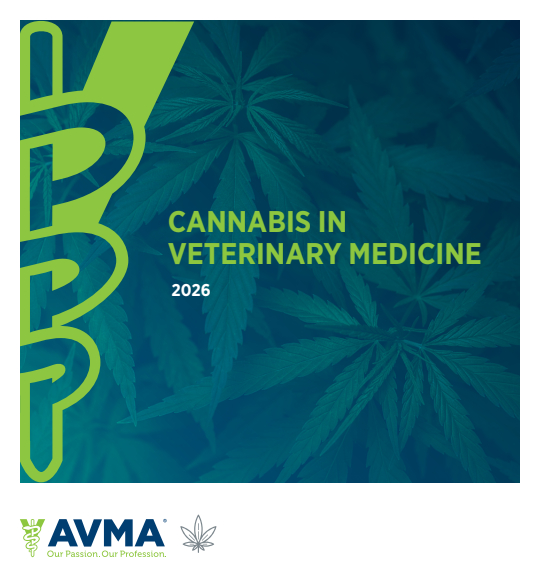
DR. ANDRE: My first comment is hooray! I think this is beautiful to see. Good timing. We’re all excited for the AVMA to really be recognizing the fact that practitioners do need our veterinary medical associations to have a voice, especially in emerging medicines, when there’s a lot that’s not known.
That is the role of a VMA, is to put those best practices and consolidate all that information together, so timely and also in time. So, yay! Good for you for putting it out now.
Importantly, they have some amazing authors, some amazing contributors, which is why this work is really well done. Some previous work, both AVMA but also other organizations, would often have their terminology incorrect, so it would make it very difficult to apply to clinical medicine.
This one is a really well-written document that does give a very complete overview of cannabis in veterinary medicine, does a great job of reviewing the studies we do have, good on the definitions, all of that. I think that it is hard for a practicing clinician to digest and then interpret into clinical practice.
Why Cannabis Medicine Is Still Difficult to Apply in Practice
DR. ANDRE: So, in answer to your question, I’ve not necessarily seen this suddenly explode in terms of now practitioners know how to utilize it in the clinic, because that is hard. There are so many products, and there are so many molecules, and it is such an art as well as a science.
I’m not sure that we’re quite seeing the boom that we would hope would come after this great report, but I think that’s because we’re missing a little bit of the clinical interpretation, “Now what do I do?” But I do think that this is a really great summary, great thing to read, great for pet parents to be aware of, and it is really well written.
– DR. ANDRE
TRIPAWDS: Oh, that’s so good to hear. Now, if somebody like me took this report or mentioned it to our veterinarian, what resources could we give them more on the clinical side? Would they come to somebody like you? Would I say, “Hey, you want to talk to Dr. Andre about this if you want to do this in your practice?”
DR. ANDRE: Yes, that’s a great way to have that conversation. And with this report out, it gives pet parents who are interested in cannabis that footing to go to their veterinarian, especially if they haven’t been receptive in the past.
This just puts it on the table. We should have this conversation. It is backed by science. We do have this clinical research, and we have it in animals now, as well, when we used to just work off human data.
– DR. ANDRE
If that clinician is maybe not comfortable with drug-drug interactions, other modalities, or other supplements, that’s exactly where our team can jump in. We just started holding office hours. We meet twice a week, Tuesdays and Fridays, that are just open, where clinicians can come, and pet parents can come.
DR. ANDRE: I’m frequently on there. Sometimes our medical director is, one of our VCCs, but it’s just meant to be an easier access point. I think that might be, my hope is, that it’s a really great place for clinicians to come if they have this idea they want to try for a case, but are maybe a little bit unsure, or want to look at a COA, a certificate of analysis, with our team. My hope is that it just takes those last few barriers away. That’s the hope, at least, and it’s been fun to start.
TRIPAWDS: That is really cool to know about, and I will definitely be mentioning that to members of our community who bring up the topic in their posts with us. As I was saying to you earlier before we started recording, over the years, it feels like there hasn’t been that constant chatter about cannabis medicine.
I know people are using it. It has occasionally dropped into the conversation in our community, but it’s not people coming out and saying, “Hey, what should I try?” or “Is this product any good?” I’m not seeing those kinds of questions that I used to see a few years ago. Can you tell me why you think that is?
DR. ANDRE: Yeah. I have thought about that a lot because we see sort of the same trajectory of the cannabis industry in other countries, and it’s interesting to watch similar patterns unfold. We scratch our heads and say, “I wonder why we didn’t learn our lesson from the last time we tried that.”
My current impression is that often the industry is not tied in to medicine practitioners, so it’s very easy for the industry to crank out volume, CBD products, CBD products, CBD products, and not really pay attention or make available some of the really amazing smaller molecules, terpenoids, different ratios, and that’s what we really need from the medicine side.
– DR. ANDRE
I think that because we did have a disconnect from medicine and industry to begin with, we really saw them stay separate, and the industry just keeps trying, but you really see them just cranking out the same product with a different brand on it, a different label, a different pretty picture.
In fact, my team is working with a case now in New York. We’re trying to find a product to put a couple of seizure patients on, and it’s incredibly difficult. It should not be that hard in 2025 to find a safe product with a good COA, but it is. I think that speaks really strongly to barriers that still exist, really getting industry and clinical practice to merge.
It makes it hard for clinicians to get the work out of cannabis. Does that make sense if I say that? To actually really leverage it in a case, instead of it just being a CBD molecule, maybe it works, maybe it doesn’t. I think we’re missing some of those really good power pieces, power players in some of the plants.
TRIPAWDS: Oh, I would totally agree. I mean, the cannabis plant is incredible, and most people, just like you said, they think about CBD or THC, and that’s all they keep hearing about. When I was studying to be a guide, I was just shocked at how many molecules are in there, and the different roles that they play to bring a system back into balance.
It is astonishing. What you just said absolutely makes sense. Yeah, we are just not pushing it enough. So one of the reasons I want to have you on today was so we could talk a little bit about that because you mentioned how hard it is to find a good product and a safe product, most importantly.
Now, a lot of people don’t think of it as being unsafe because it’s a plant. How can that be dangerous? But I think the more that you become acquainted with any kind of nutraceutical or a plant like cannabis, we’re learning, yeah, there can be some hazards out there.
I think in a lot of cases, when a tripawd parent is desperate for something to work, they will reach for anything, and we understand how that feels when you just want to help your pet feel better, but there are some precautions that we need to take.
TRIPAWDS: Let’s talk about pain management and how cannabis medicine can assist in a situation where a tripawd either has chronic osteoarthritis, they’re aging, and they’re having trouble getting around, and nothing is working.
Can a cannabis product be effective on its own? Is it the end-all be-all? Or how do we know what to turn to when we’re trying to investigate it as an option?
DR. ANDRE: Such a great question, and I really like the framing around a pet parent who sees their animal in pain. I think you’re describing a situation where, like, we need an answer now.
We want to have something in our hands that makes my animal feel better soon. That is both completely understandable and the story of most pet parents, but also where the industry really takes advantage of clients a lot of times, because if a product can be put into your hands easily, if it’s accessible in every pet store, it’s just easy to fall into that.
– DR. ANDRE
Helping Pet Parents Make Informed, Thoughtful Choices
DR. ANDRE: Maybe a word of caution I would slip in to pet parents listening is still do your research. You want something that’s really going to serve your animal’s body’s needs, and it’s not going to be dictated by the color of the label.
So, just really having your critical thinking hat on and being willing to look at a label or call someone for help gets you what you need, even if it’s a few days’ delay. It is really is worth it to have all those beautiful molecules in the background that really match what’s going on for the animal.
And so, yes, cannabis can be solo, by itself, a really amazing pain control. We’ll sort of skip over which molecules work the best, but there are some that are better for osteoarthritis, some better for muscle spasm, so tailoring the molecular profile can really dictate how good it can be on its own.
– DR. ANDRE
If it’s a CBD isolate, so that’s the only molecule in the bottle, it’s probably not going to be as effective as you want it to be, because your animal does have some things going on in their body.
Doesn’t mean it’s not going to help, but again, that’s why I always encourage, let’s look at the COA. Let’s actually figure out which molecules are in there. A CBD-dominant complex spectrum has lots of beautiful molecules in the background, in itself can be really, really effective for pain control, and it is going to help on the inflammatory cascade, absolutely.
How Cannabis Supports Pain Control, Sleep, and Healing
DR. ANDRE: One of the things that I really love about cannabis in general is how much it resets other body rhythms. Letting the animal sleep, letting the animal eat, letting the animal feel like interacting, and those, in and of themselves, have pain control effects, because it gives the body time to repair itself.
So that’s always an important part to keep in mind about cannabis is that it is the pharmacological effect of the molecule, so what it actually does when that molecule enters the body, but it’s also what it allows the body to do on its own. When we combine those well, that really is the best that we can try to do for our animal of having normal rhythms in their body.
TRIPAWDS: You know, when you talked about all of the different ways that it will help the body, it’s funny, because thinking of sleep as pain management, a lightbulb went on in my brain. You are absolutely right. Rest is relief.
DR. ANDRE: Yes!
TRIPAWDS: So, if you can find a product with just enough to keep your animal comfortable at night and not waking up anxious and panting, boy, that gives both of you a chance to heal.
DR. ANDRE: Absolutely, and I love that you emphasize both. If you can get a good night’s rest, you are better able to look at your animal and figure out what they need, have more tolerance when you’re interfacing with the medical community. It just is good.
It’s surprising, even this far into our career with cannabis, how often when we’re journaling, that sign comes up as one of the biggest changes. My animal is sleeping. I’m sleeping. My animal is eating. I’m eating, right? And that is more of my day-to-day practice, that interspecies medicine portion.
It’s not always about just the molecules, often it’s about how does this family work together, and what are we actually problem-solving for? What would be the most use? And sometimes it’s not just pain. It’s how does this interact as a unit, as a holistic unit.
– DR. ANDRE
TRIPAWDS: That is holistic, right there, what you just described. It is such a great way to address a situation that it feels so overwhelming at times. We all want that magic pill, that one thing that’s going to take care of all, and it takes work to find the perfect blend of molecules.
That’s why I always encourage people to talk to somebody who understands cannabis medicine, to contact your organization for a consult, because I have enough to think about right now. I go to a pet store, and I see all these products, these hemp-based products, and it’s overwhelming. I can barely choose my dog’s food. That’s a lot of work. I turned to a consultant for that recently. We’ll offload some of that work to somebody who really understands medicine.
But for our purposes today, we’re just going to give a light overview. We’re not going to tell people what they should buy and what they shouldn’t buy. We want people to be aware of these things so they can have a good conversation with somebody who understands cannabis.
DR. ANDRE: Absolutely, and to be encouraged that it is a modality that can bring a lot of relief regardless of which area we’re working on. I would say to stay encouraged that it is worth pursuing, even if it feels overwhelming. Cannabis medicine, once you learn the basics, is really fun and very pet parent applicable.
It is our goal to teach pet parents the basics so they can work on that on their own, and then be in the background if they need help. So, don’t get overwhelmed. You got it. Dig into it. It really is a great modality.
TRIPAWDS: Yeah. Becoming a guide, I highly recommend it to any pet parent like me who just wants to understand the medicine more, because you do feel more empowered, even if you don’t completely understand it. At least you have a basis for asking good questions.
Now, one of the things I wanted to talk to you about also was, let’s discuss how cannabis can interact with some of the pharmaceuticals that our dogs and cats might be taking. Gabapentin, for example, I heard a vet call it Vitamin G, because it’s just so common now, so many pets are taking it, and especially in our Tripawds community.
What interactions, what are some of the types of medications that we might want to look at and carefully consider before putting our pets on any kind of cannabis product?
DR. ANDRE: Another great question. Gabapentin is definitely one of those, so we’ll talk about that one, because it has a little bit of a unique interaction mechanism. In general, cannabis is gonna interact with everything. It goes back to endocannabinoid system and the way that it is kind of whole body balancing.
So, even if we don’t know a direct drug-drug interaction, it is going to change our dose, even for an animal that’s taking some anti-anxiety medication, and yet they suddenly feel better in their body. Well, we need to also lower that other dose.
Bottom line is being in constant conversation with your care team. Really keeping good journaling, and knowing that the body changes over time. There is no medicine, whether it’s prescription or botanical, that is ever static, especially in a patient that is rapidly changing, like a tripawd. There are things going on in their body, so being able to adapt is really key to that.
– DR. ANDRE
Understanding Drug Interactions and Liver Metabolism
DR. ANDRE: Medications that we watch out for the most would be ones that are metabolized through the liver, and that is honestly about 60 percent of our pharmaceuticals, so a lot of them. Most of our behavioral medications, a lot of our pain meds, non-steroidals, steroids — these all have interactions, but often they are in positive ways.
Many times, by using cannabis, we can get the dose of a pharmaceutical lower and use them in conjunction. So, it’s not a negative interaction, but everyone does need to be aware that it’s happening.
Again, holistically, we can make some changes. If your animal is on drugs of any kind, pharmaceuticals, the prescriber does need to know that interactions are possible, and they can always reach out to us if they have questions, etc.
Our medical director, Dr. Gewehr, just finished, actually a year ago, probably now, his thesis in cannabis, and his research was on the use of cannabis as a preanesthetic, and demonstrated that the dose of propofol that you need is much lower.
So that’s one of the first. There are some great studies out there, a lot on pain, some on behavior, but really one of the ones that really demonstrates why we need to know, because there are interactions that affect our dosing. So, those are some of the ones that would be common. Blood pressure medications, seizure medications, all of those do have interactions.
And then just to tie it back to gabapentin, that one absolutely has interactions with cannabis because of how they both work on the calcium channels in the brain. All that to say, though, if you have those interacting, often we can get the pharmaceuticals lower. So, there are few reasons that we would not use cannabis when there are other drugs on board, but in all of them, the entire team needs to know what’s going on, because it will affect dosing.
– DR. ANDRE
TRIPAWDS: That’s super good to know, and I think that the publishing of the AVMA’s report makes mentioning cannabis use at our veterinary visits a little less scary. I know that in the past, a lot of pet parents didn’t want to mention that they were trying any kind of cannabis product on their pet. Now we won’t feel like a criminal or just a bad person for trying to help our pets with it.
I like that the discussion is out there now. We don’t have to be afraid to tell our vet that we’re using it. The important thing is to tell our vet. If you’re just even buying something off the shelf at a pet store that is a hemp-based product, any kind of cannabis product needs to be discussed with the care team.
Now, cannabis medicine keeps evolving, as we mentioned earlier. I’d like to hear from you what are some of the new breakthroughs that you’ve seen in how it’s being used to treat various types of conditions?
DR. ANDRE: Well, I will take the opportunity to focus on some of the stuff that I love working on because I think that’s probably more of a fair way to couch the question. The fact that cannabis medicine has become so pervasive, as it should be, there are specialties now within it. Are you working on oncology? Are you working on cardiac diseases?
And so you begin to see the specialties themselves begin to have cannabis-based knowledge. I work in a lot of behavioral health, and so some of the really fascinating ways that I’ve seen, or more developed my own practice really is in trying to balance out the emotional health of all of the species in the family, and that includes the humans, as well as the dogs or the cats and thinking about how this has implications in physiology.
Is the animal able to do well in their actual medicine case because they now interact well with their pet parent? We can journal. We can actually tell if something is going poorly or not going well at all. When we work with interhousehold dynamics, it might be, maybe cats that are fighting.
Maybe we’re dosing multiple cats and then having some guided playtime while that neurology, while those circuits in the brain are really receptive. So, I think that, for me, is one of the most interesting things that has come up for being able to use cannabis is setting the physiology in a state that is more malleable and then what we do with that.
It’s not just about tossing the pill, giving a dose, and then hoping something gets fixed. It’s really about knowing when that body is most receptive, and then how we are guiding that. So, I have to say that that’s probably one of the most fascinating things that I see come up and has implications across all of our medicine fields because behavior really is just a sign of what’s going on in the internal systems.
– DR. ANDRE
TRIPAWDS: Wow, so you are actually working with clients that may have pets that aren’t getting along, and you might suggest, okay, we’re going to try this type of molecule on this cat, and maybe going to try this other one on your dog. And then we’re going to study and see how they get along?
DR. ANDRE: Absolutely. Yeah, and we’ll pull it back to your Tripawd audience for a moment. Do any of your listeners have issues with the other household pets after one has its amputation? Are those dynamics ever difficult for owners to manage? What are your thoughts on that?
TRIPAWDS: You know, a lot of people are afraid of that. They think that their other pets are going to treat the amputee differently. Generally, what we see is they smell different when they come home from the hospital, you know? But generally, they give them a little more space.
What we tend to find is they’re too active. They’re not being mean to them at all. They want to play and treat them like they did before the surgery. So, keeping them calm is a big deal in the community.
Using Cannabis to Support Calm Interspecies Interactions During Recovery
DR. ANDRE: Yeah. What I might suggest there is we have a recent amputation that we really need to rest, maybe a complicated procedure or something else going on, other condition-wise. And yet we still want to manage these beautiful interspecies interactions, let them have that companionship.
But maybe we need to be doing some massage for both and using cannabis in either both or one or the other so that we’re really setting the tone for what’s going on in each of their bodies, letting them interact in some more calm ways.
That could be a really good example of continuing to reinforce that bonding without some of the concerns of being too active, or depending on what that pair is, that there would be frustration between the two because they can’t do the same things that they used to. So, thinking more about cannabis as its neuroplastic properties, and then what are we doing to guide that experience
TRIPAWDS: Oh, that would be really cool to use in a situation like that. I think of so many people who become really stressed out when they feel like they have to divide up their pets in the household for two solid weeks at minimum because they know their dogs are going to be too active together, or the cats are going to be jumping, and that sort of thing.
I would love to see a day where cannabis medicine was so effectively used that the cone-of-shame would never be needed.
DR. ANDRE: Yes, how great would that be?
TRIPAWDS: That would be amazing. I’m so happy that you’re out there doing the work that you do because it’s needed, and there is so much more that this plant can do in so many situations, but especially when it comes to differently abled animals and animals recovering from surgery.
Our community is just barely scratching the surface. I’m always going to refer them over to the Veterinary Cannabis Consultant for a really great chat about their needs. Anything else that you’d love to share with our community?
DR. ANDRE: Let’s see. I think I would say in closing, mostly a repeat of the things we’ve already covered. Dig into cannabis. It really offers a lot for an amputee, from behavioral effects, psychological effects, physical effects, and sleep patterns like we mentioned before. So, just because it feels overwhelming or the industry seems kind of flaky sometimes, the plant itself has some amazing properties.
If we can really pull medicine and science into how we’re designing that protocol, there’s a lot of benefit behind that. So that would be one: stay curious, don’t get overwhelmed. You got it. Stick with the science, would be the next one, and not get distracted by brand/marketing. Never be afraid or ashamed to ask for a COA.
Why Product Quality and Transparency Matter for Pet Parents
You, as the pet parent, have the right to see the lab report, and if you call a company and they give you the brush off and aren’t very transparent, there are other products out there. Having high expectations from the industry is how we make it change. So, pet parents, stick to that battle. We deserve to see really good lab report information about anything that’s going into our animals.
– DR. ANDRE
That ties into my last point of recognize how important your voice is to emerging industries. As we don’t know a lot, it is always guided by our love of our animals, of pet parent-initiated, what are we gonna do, we’re going to figure this out together.
Just because we don’t know the answer, digging into it with each other in community as a collective, really is how we get that best answer. You’re important. It makes a difference what you’re looking for, for your own animal.
TRIPAWDS: Well said. I couldn’t agree more. When I was training to be a guide, I remember approaching a few companies about their COAs and getting the runaround. It’s amazing.
They just want you to click and buy, or go walk into a store and go buy it. They don’t want those questions if they’re not a good player. Our goal is to find the ones who are willing to answer our questions. They’re out there.
DR. ANDRE: Absolutely. For sure. And they stand out, yeah, they absolutely do. Again, this case I mentioned that we’re working on, one of our team VCCs all day today has been calling product companies, and she’s just amazing at it because she knows what she’s asking for. She’s like, nope, that’s not what I said. I want to see your COA. Just to really be intentional about how the best care that you want for your animal.
That applies to our botanical substances, our pharmaceuticals, and we have to be aware. It’s easy to get overwhelmed and just go with the flow, but we’re there to advocate for the animals in lots of ways. And definitely botanical medicines, looking at a certificate of analysis is a super important way to know what’s going into their bodies.
– DR. ANDRE
TRIPAWDS: Yeah, definitely. It brings to mind a medication that a lot of pet parents in our community are familiar with called Librela. When Librela came out, it was touted as this wonderful osteoarthritis medication, and I even gave it to our dog.
Then, suddenly, these reports started coming in from pet parents asking, “What is wrong with my dog? They can’t get up!” It was really scary, and it caused the industry to dig in and say, “Okay, what’s going on here? Why are certain dogs impacted so negatively by this medication?” And it’s all because of the way that pet parents raised their voices and said, “I don’t like what this is doing.”
And it’s the same way with any kind of botanical medicine, too. We need to advocate for animals and be vocal about it if we don’t like what we’re seeing.
Thank you so much for being here today. It’s great to have you. I was just thinking we could do a whole show on COAs.
DR. ANDRE: So many things!
TRIPAWDS: That is something that we should all know more about. I’ll definitely post some resources and some of my previous articles in the blog post for this show. Anytime anybody has any questions, I know where I’m going to tell them to go. Why don’t you tell them, Dr. Andre?
DR. ANDRE: Well, thank you so much. We have definitely sent some patients your way to make sure that they’re getting supported from that community aspect. What do I do? What equipment am I supposed to be looking at? It’s really lovely to have this collaboration. Always a pleasure to chat with you.
For anyone who’s looking for us, you can find us at www.veterinarycannabis.org is our website. reception.desk@veterinarycannabis.org will come to our inbox team, and we’ll be able to help you land in the right spot, no matter what you’re looking for.
And again, as I mentioned, we do have our true consultation arm, but now we’ve just opened office hours, and we meet every Tuesday and Friday, and it’s available. Hopefully, that becomes a resource where someone can just drop in and ask questions or listen to others talk about cannabis.
Also, our certification class is open to non-medical individuals and pet parents. We love to see everyone show up there. It’s really my favorite class to teach, and it’s meant to equip everybody about how to advocate for the animals that are in their lives.
TRIPAWDS: Definitely. Don’t be afraid, just because the word “medicine” is in it, everybody. I’ll tell you, I am not a medical person at all. I was a little terrified to step into that class, but I learned that it is very user-friendly and very pet-parent-friendly. I learned so much without making my brain explode, and it stuck. I still feel pretty confident about what I learned.
DR. ANDRE: That’s great!
TRIPAWDS: I’m just always trying to look for new ways to expand on that knowledge, so I’m really thankful to have you here today, Dr. Andre. Thank you so much. Keep up the great work!
DR. ANDRE: Thank you so much.