Pet cancer is terrifying. But there is hope for better days ahead. Treatments are getting less invasive all the time, thanks to groundbreaking minimally invasive techniques and a new process being studied called “sentinel lymph node mapping” that give our pets a better shot at living with cancer, not dying from it.
In this episode of Tripawd Talk Radio, we talk about this groundbreaking research with Dr. Maureen Griffin, a surgical oncologist leading the way with innovative treatments at Colorado State University’s Flint Animal Cancer Center.
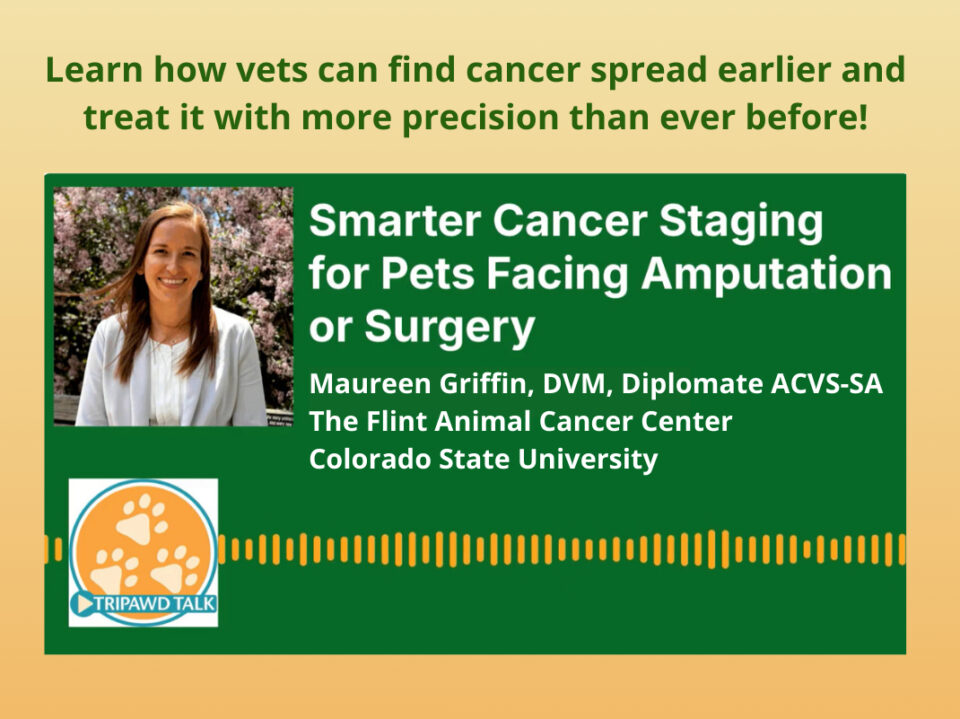
Advances in minimally invasive surgery and “sentinel lymph node mapping” are helping veterinarians detect cancer spread earlier and treat pets more precisely.
Dr. Griffin is an expert in this exciting new area. Today she explains how minimally invasive techniques can reduce pain, shorten recovery time, and sometimes allow diagnostics and treatment to happen during the same procedure.
The conversation also dives into her 2025 sentinel lymph node mapping study. It’s a technique is used to identify the lymph node most likely to be the first site of cancer spread, even when imaging looks normal.
What You Will Learn in This Episode
This episode is especially helpful if you’re navigating a pet cancer like mast cell tumors, anal sac tumors, or other cancers where lymphatic spread plays a major role in treatment decisions.
What minimally invasive cancer surgery looks like in veterinary medicine today
Sentinel lymph node mapping helps identify where cancer is most likely to spread first
CT scans are valuable, but may not detect early lymph node metastasis
Pet parents can and should ask about staging options and referral centers when navigating a diagnosis
You can tune into the podcast below, watch the podcast on YouTube (video is below), and the transcript is at the bottom if you love getting into the details!
Tripawd Talk #133: Smarter Cancer Staging for Pets
Subscribe to Tripawd Talk Radio in your podcast player app!
About Dr. Maureen Griffin, DVM
Diplomate ACVS-SA
ACVS Fellow, Surgical Oncology
ACVS Fellow Candidate, Minimally Invasive Surgery (Small Animal Soft Tissue)
Assistant Professor, Surgical Oncology
Colorado State University Flint Animal Cancer Center
Dr. Maureen Griffin is a board-certified veterinary surgical oncologist and Assistant Professor of Surgical Oncology at the Flint Animal Cancer Center.
She completed advanced training in small animal surgery, a surgical oncology fellowship, and specialized fellowships in both surgical oncology and minimally invasive surgery.
Dr. Griffin’s clinical and research work focuses on minimally invasive and interventional techniques for cancer treatment, including sentinel lymph node mapping and advanced imaging approaches to improve cancer staging and outcomes.
She works closely with multidisciplinary oncology teams to help pets receive precise, patient-centered cancer care while advancing the field of veterinary oncology through research and education.
Resources
CSU Flint Animal Cancer Care Center
The role of minimally invasive surgery in oncology – part 1: laparoscopy
Minimally invasive iliosacral sentinel lymph node mapping and extirpation: A canine cadaveric study
Cutting Edge Care: The Evolution of Minimally Invasive Veterinary Surgery
Tripawd Talk #133 Transcript: Dr. Maureen Griffin Describes Smarter Cancer Staging for Pets
TRIPAWDS: Dr. Griffin, it is so nice to have you here today on Tripawd Talk. Thank you so much for being here.
DR. GRIFFIN: Thank you so much for having me. I’m really excited to be able to join the Tripawds community. I think it’s a really incredible group, doing great work, and really excited to be a part of this, and happy to be able to speak about this today. So, thanks for having me.
TRIPAWDS: Oh, you bet. We are always trying to learn and grow in our knowledge here and be able to help people as they go through this cancer journey, because this is the education no pet parent ever wants, and we find ourselves thrown into it a lot of times with no awareness, no knowledge.
That was me when our dog got diagnosed with osteosarcoma. I didn’t even know dogs got cancer. This was so long ago, but it’s still a huge learning curve for the average person to understand concepts and treatment and what to expect. Having you here today to talk about lymph node mapping is really exciting.
When I was first presented with the type of work that you’re doing, I’ll admit, I was like, wow, this is a little bit over my head.
But the more I read about your work and just gleaned a little bit from your research, I thought, this could really help pets get through the cancer treatment, have better longevity, and just give us more options to choose from when we are pursuing some kind of cancer treatment.
I want to have you start by giving us a little background on what it is exactly that you do over at CSU.
DR. GRIFFIN: Awesome, yeah, thank you so much, and I can completely understand that sentiment. You know, I think even for us, things can get overwhelming, the amount of options that there are, the advancements in technology.
You know, we are so fortunate to be in a place where we really are on this cutting edge of veterinary medicine and have access to a lot of really advanced techniques and technology, where we can keep pushing those limits forward.
But yes, to answer your question, what we do at CSU, I’m very lucky to be a surgical oncologist there within our comprehensive oncology cancer clinic.
So the Flint Animal Cancer Center and the comprehensive oncology clinic that we have, I think really offers an incredible opportunity where we all work together.
We have this multi-modality approach to cancer, meaning that my background in training is surgery, having done a surgery residency, and then done a surgical oncology fellowship at the Flint Animal Cancer Center at CSU, and then being combined within a very intimate group setting with our medical oncologists and our radiation oncologists.
Having this level of expertise from all of the different dynamics and pillars of cancer care really allows us to come together so that we can best assess and really understand the disease processes of the pets that come to us with cancer, and know how best to be able to treat them, which often is a combination of our different techniques.
I think an added benefit that I really enjoy is just that having those really frequent communications with my colleagues, about our more complex or challenging cases and how we can best manage them and help them.
I think really gives us some great insights into where we are currently in veterinary medicine with cancer care, and then where we’re not, you know, what we don’t know, and what we need to learn to be able to advance that cancer care and continue to improve our patients’ outcomes.
I ask, and I think all of us ask on a regular basis, how can we push those boundaries of where we currently are to improve outcomes in our pets with cancer?
And I think, potentially in a translational fashion as well, you know. We’re learning a lot from the human, and what we’re doing has the potential to help human patients as well.
So, it’s really an incredible group, I think, team dynamic setting, where we’re kind of maximizing our ability to care for patients right now, but also kind of maximizing our communications and research and collective knowledge to be able to continue to advance that patient care as we move forward.
TRIPAWDS: And what you’re doing at CSU is the kind of knowledge that eventually gets to regular veterinary oncology practices, private practices around the country and around the world, so it kind of all starts with the type of research that you’re doing.
What is the difference between a veterinary oncologist and a surgical oncologist?
DR. GRIFFIN: Great question, yes. So, I think, probably when we refer to a veterinary oncologist, for the most part, we’re referring to the counterpart in a human oncology setting, which is a medical oncologist.
These are oncologists that are really background training and skill set with chemotherapy techniques, a lot of diagnostic modalities as well, really working up what patients have understanding to the best of our abilities, their cancers, the biology of those cancers, where it’s gone to, and how can we best treat them, often with more of a medicine-type focus.
A surgical oncologist is the flip side of that, and saying “How can we use surgery to treat cancer?”
Our training is quite different in terms of backgrounds, and medical oncology residency is also a prolonged training program, really focused in the medical component of treating cancer, so specifically chemotherapy being a lot of that.
There’s a lot of new techniques that are being invested, like immuno-oncology, how can we use the immune system, and treatments from the immune system to kind of gear up and fight against cancer? That’s a lot of the medical oncology side of things.
The surgical oncology side of things is, “How can I use surgery as one of our tools, in a lot of different ways, for our pets with cancer?”
Diagnostic modalities, if we need to go in and get biopsies or assess these lymph nodes by removing them, we’re helping with that. And then from a treatment standpoint, being able to remove tumors in all sorts of different locations.
Potentially even providing more palliative options, placing ports and things like that that we can use to try and help treat our patients, but using surgical techniques to treat our pets with cancer.
TRIPAWDS: Oh, that is so fascinating. It is very different, and I had an experience with our dog, Nellie, earlier this year, who, she had a lump that just exploded overnight on her torso, and took her to a surgical oncologist, just because we travel around, and we were in the area, and I knew this gentleman; he’s a CSU fellow. He saw her.
He took the tumor out with surgery, got really great margins, and considered it mostly curative. Very low, low risk of recurrence. It was just like a grade 1 soft tissue.
But it was really cool that kind of treatment is out there, when you need it. And I’m so grateful for the work that you’re doing, because one of the things I’ve read that you’re focusing on is minimally invasive surgery.
So, tell our listeners what exactly does that mean as far as the diagnostics that are minimally invasive, and then the treatments that you do?
Let’s Talk About Minimally Invasive Surgery in Veterinary Oncology
DR. GRIFFIN: Absolutely, yes. No, thanks so much for bringing that up. Yeah, I feel really, really fortunate to have had great exposure to minimally invasive surgery throughout my training.
What that means is basically making really small incisions into our pets with cancer, to be able to treat them or do our diagnostic assessment, kind of our explorers, to be able to look at organs, look at lymph nodes, or remove certain structures within the belly or the chest, of dogs and cats with cancer, but through a minimally invasive approach.
Instead of potentially opening their abdomen or chest with a bigger incision, we’re often able to do that with these really small little incisions.
Then we put ports into their chest or abdomen, where we can introduce a camera, kind of a big scope, what we call a telescope that’s attached to a camera, so then we can see that on a screen.
Our instruments go through those ports as well. We’re basically able to do a lot of surgical procedures within a chest or an abdomen using 5-millimeter ports and scopes and instruments, which is very much kind of what we see in the human realm of things now.
You know, if a person goes to a surgeon or an oncologist now for treatment of an intra-abdominal tumor, like an adrenal tumor, the first line of treatment or surgery is often going to be a minimally invasive approach for select cases where it’s available.
We’re fortunately able to do that for a lot of our pets as well.
And we know that there’s really clear evidence in people, and I think that evidence is growing in our pet patients that there’s a lot of benefits to doing things more minimally invasively when that’s possible.
How minimally invasive surgery reduces pain, recovery time, and surgical impact
We know that the smaller incisions, the decreased tissue trauma and manipulation results in less pain for our pets post-operatively. They tend to need less heavier-hitting pain medications like our opioids. Their hospital stays are often shorter. They seem to be able to return to activity more quickly.
There might also be a decreased risk of complications in some of these patients as well, which has been shown in some different studies and quite apparent in a lot of human studies.
And I think it’s also really helpful to me as a surgeon, too, because in a lot of these cases, I’m able to visualize structures much better, structures where they’re really deep in an abdomen, and it’s taking a lot of effort to retract things,
We can see, with some of our minimally invasive approaches, those structures are so evident to us with a lot less tissue trauma and manipulation.
And with the technological advancements that are coming with human surgery, even, like, robotic applications, these things are coming to veterinary medicine, and our minimally invasive surgery applications are going to potentially allow us to be more precise from a surgical standpoint.
My big questions are:
- “How can I optimize both the oncologic outcome, meaning the cancer care?”
- and “Do I want to be able to optimally remove the patient’s disease and give them the best outcome possible from a cancer standpoint?”
- and also, “But can I do that in a way that also optimizes what I consider to be a patient-centered outcome?”
So, decreased pain, improved recovery, those types of outcomes for our patients as well. Being able to combine the cancer focus with the minimally invasive approach when it’s appropriate, I think, is really optimal patients’ benefit in a lot of different ways, and that’s really kind of my overarching goal to a lot of my career and research.
I feel so lucky to have been able to have really advanced training in surgical oncology and minimally invasive surgery, that’s provided me with the skill set to be able to do that for our patients and continue to push those boundaries forward, to hopefully make minimally invasive surgery applications even more available for our pets with cancer.
TRIPAWDS: That would be so awesome, because I know there aren’t many of you out there, at least in private practice. When I looked for a surgical oncologist for Nellie, there aren’t many right now. How many would you say are practicing?
DR. GRIFFIN: That’s a great question. For a surgical oncologist, that’s a very good question. Last time I checked, I think there might be in the ballpark of 50 or so that have done a fellowship program or are boarded fellows through the ACVS, the College of Veterinary Surgeons.
That definitely is growing, but right now there’s only a handful of centers that train fellows every year, CSU being one of those. So, it’s been a really incredible opportunity to be on the flip side of that.
I was a fellow there doing my training, and now I’m training fellows at CSU, so it’s really fun to be a part of that training for people that are really passionate about cancer care and using surgery as a way that we can improve outcomes in pets.
Also from a minimally invasive standpoint, that skill set is really being incorporated a lot more and more into residencies and training programs.
There are also fellowship programs now that are really starting to grow the number.
But we’re still in an early phase of that where there’s a few fellowship programs currently that are offering more advanced training in minimally invasive surgery as well.
So, I think those numbers of us will just continue to grow over time. Again, I just feel super grateful to have had the opportunity to do both and really be trained by incredible groups of people in both.
TRIPAWDS: Yeah, we’re at the dawn of a new era in this type of treatment. It’s very exciting, and what are some of the cancers that we’re talking about that can generally be treated with minimally invasive techniques?
Which cancers can be treated with minimally invasive techniques?
DR. GRIFFIN: Yeah, that’s a great question. So, there’s really all sorts, I would say, at this point. I think that the applications are just continuing to grow. It ranges from diagnostic, palliative, to really treatment-based therapeutic.
Diagnostically, we can go into an abdomen or a chest and do, like, a diagnostic explore with a camera and take biopsy samples of different tissues minimally invasively.
We can do other palliative-type techniques, so dogs that have fluid building up in their chest or around their heart, we can go in with a camera and kind of remove the structure around the heart, the pericardium, to be able to kind of help alleviate that pressure and even put a port into their chest so it’s more easily able to be drained minimally invasively.
So, a lot of palliative techniques that we can do very minimally invasively.
And then from a tumor removal standpoint, tons of opportunities for that, too. Tumors themselves, and also lymph nodes, other structures that could have sites of spread of cancer, we’re able to remove minimally invasively.
From an abdominal standpoint, there are minimally invasive approaches where we can remove adrenal tumors, which we mentioned before.
Kidney tumors, we can remove splenic masses, even bladder tumors. I think applications are continuing to grow, pancreatic masses in the chest, we’re able to remove a lot of lung tumors minimally invasively with just very, very small incisions.
So instead of needing to open up their chest, we can do this all minimally invasively, which I think definitely has a big benefit to those patients.
Other tumor types in the chest that we can see in front of the heart, like thymomas, can often be removed minimally invasively.
I think the sky is the limit. It seems to just be growing in terms of what we’re able to accomplish minimally invasively.
We’ll continue to push that boundary forward, so it becomes even more accessible for different tumor types in different settings that maybe right now we don’t think are as appropriate for minimally invasive surgery.
And we’re seeing that shift where things that weren’t minimally invasive 20 years ago now are. I think we’re on that same curve, too. We’ll just continue to see more and more opportunities where we can offer minimally invasive options for our patients.
TRIPAWDS: That is so exciting. So, are you saying something like hemangiosarcoma could be treated with this type of technique?
DR. GRIFFIN: Potentially, yes. We can remove splenic tumors minimally invasively. There are some limitations, somewhat. If it’s a 10-centimeter tumor, unless we have some technique where we can really well seal off the tumor within a bag and then morse later, break it up into very, very small pieces to then remove through a small incision.
If we don’t have access to those tools, then we still have to make an incision big enough to get the mass out.
So there becomes some point where it’s just almost the same incision size to be able to remove the mass open versus minimally invasive. But there are a lot of scenarios where we can. Smaller tumors, we can definitely take out minimally invasively.
I think that there’s a really nice kind of minimally invasive assist opportunity as well, where we can make a much smaller incision and still do a really nice explore with a camera throughout the abdomen.
We can take liver samples, assess other structures that might have concern for metastatic disease, and sample those with a much smaller incision, and then just take out the spleen through a 5-centimeter incision instead of a 20-centimeter incision. So, there definitely are a lot of ways that we can address splenic tumors minimally invasively as well.
Understanding lymph node metastasis and why it matters
TRIPAWDS: Things are a lot more hopeful than they used to be, for sure. And you mentioned a key word here, metastatic disease. That is something that we all become familiar with when our pet gets diagnosed with some type of limb cancer that requires amputation, typically osteosarcoma, for our community.
That was one of the things I wanted to talk to you about today, is your work in identifying lymph node metastasis.
We tend to understand right away that, yes, amputation will take care of the pain, but it won’t get rid of the cancer, and eventually it’s going to come back and spread. Usually in the lungs, but sometimes elsewhere.
TRIPAWDS: Is your work focusing on finding that cancer before it spreads? And if so, how does that happen in the process of working with a pet?
Let’s say I have a dog who has been diagnosed. Do you go in, and do you look at the lymph nodes right away?
I’ll just say, take me through the journey. If I bring my dog in to you, what happens? What are you looking for?
Sentinel lymph node mapping: finding cancer earlier
DR. GRIFFIN: Of course, yeah, it’s a great question, and it definitely differs for different tumor types. So, the osteosarcoma, we know, unfortunately, it does have a very high rate of metastasis of spreading, like you mentioned, the lungs being the first stop for many of them.
For other tumor types, they tend to spread more through the lymphatics. Those are basically like the body’s cleanup and transport system, where the body takes away waste, damaged cells, sometimes bacteria, sometimes cancer cells, and that goes to lymph nodes, which are the filtering stations for the immune system.
A lot of different cancer types hijack those lymphatic systems, and they spread that way to the lymph nodes.
For those tumor types, assessing the lymph nodes is one of the earliest places where we can assess if there’s spread of cancer.
Tumors like mast cell tumors, which are very common in dogs, that tends to be kind of their first go-to. If they’re going to spread somewhere first, it tends to be a lymph node.
Anal sac tumors is one thing that we’re actively investigating with lymph node spread and different techniques. Those also tend to spread through the lymph nodes first.
The challenge is knowing what lymph node it goes to.
In dogs that have huge lymph nodes, we feel the lymph node, or if it’s a lymph node that’s deep within a body cavity, we do an ultrasound or a CT scan or something, and we see it’s really big.
We can sample it, but that’s really concerning that there’s spread of cancer to that lymph node. That lymph node no longer looks like a lymph node; it looks like it’s developing into a tumor because there’s a lot of cancer cells now in it.
The challenge is, in a setting where there’s early spread of cancer when that process is started, it can be really hard to know.
Our routine imaging techniques are pretty poor at determining early spread of cancer.
So, until that lymph node gets to be really big, we often don’t know if there’s spread of cancer. We also don’t even know what lymph nodes we should be looking at.
Some really smart people have done a great job mapping the lymphatic systems in dogs and making maps, basically.
If we have a tumor on this part of the body, where would it most likely drain to? What lymph node would it most likely go to first?
But when we’ve applied those mappings, the kind of using just our anatomy alone, trying to find early spread of cancer and removing certain lymph nodes to look for spread of cancer, we have found that we are often wrong, so it’s just much more complex.
The lymphatic highways, cancer cells don’t always go where we think that they should go, based on anatomy. This has been most studied for mast cell tumors in dogs.
One technique that’s been developed is what we call sentinel lymph node mapping.
That’s where, basically, we’re using these different dyes, or tools, with different types of imaging, where we can try and track.
We’ll often give the dye right around the tumor and then watch that dye travel through the lymphatic pathways to that first lymph node. So that’s what we call the sentinel lymph node, or the one that we think is the most at risk for that initial metastatic disease.
And that’s the one that I want to look at and assess to know if there’s early spread of cancer.
TRIPAWDS: When you say sentinel lymph node, does that vary depending on the type of cancer that the dog or cat has when you’re treating it?
DR. GRIFFIN: Yes, definitely. Again, there are different kinds of lymph node basins where some of these could go. So specifically for dogs with anal sac tumors, which are often within the pelvis and the abdomen, pretty deep within those structures.
And we know that for anal sac tumors, for mast cell tumors, if we find and remove lymph nodes that have spread of cancer, we can improve their outcomes.
We can ultimately prolong their disease process. Dogs with anal sac tumors tend to be a pretty slowly progressive process.
Removing lymph nodes that have spread of cancer, although it could continue to progress, we are improving the time frame that they have until we start to see more problems down the road, and really improving those dogs’ cancer outcomes and cancer care.
We know that we need to look in the belly, in the pelvis, for dogs with anal sac tumors to find those lymph nodes that have spread of cancer.
And so, that means for them, we can use techniques before surgery with different imaging modalities like a CT scan.
Using a CT-based dye that we can pick up with CT, but if we’re then going to try and actually target or identify a lymph node and say does it have cancer cells in it, we actually need to sample that somehow.
It can be really hard to get a needle into a lymph node within the pelvic canal in these dogs. Doing that still doesn’t always give us an answer.
Maybe we’re just sampling one small part of the lymph node, and maybe we’re missing a diagnosis of early cancer that way.
Actually, removing that lymph node gives us the most information about whether or not there’s spread.
And for a dog with an anal sac tumor, that would routinely, traditionally mean opening the belly to be able to get those lymph nodes out. Which we can do, and dogs tend to do very well with that. That’s been a very traditional technique that we’ve used for dogs that have really big metastatic lymph nodes.
But for dogs that have early spread of cancer, or we don’t know that they have spread of cancer yet, it’s a diagnostic modality we’re wanting to use to give us that information.
If it spread? How can that influence our next steps? Can that help to determine whether a patient would benefit from chemotherapy, or needs more frequent imaging, or what do we do next?
And maybe removing that lymph node, if there is early spread of cancer, that might help the dog’s outcome just by removing that lymph node itself.
But a lot of dogs won’t have spread of cancer, and so, we want to do something that’s really minimally invasive, decrease the morbidity, decrease the risk of complications, help those dogs to return to function as quickly as possible.
Doing this with a scope, with a minimally invasive approach can really give us that optimized staging information, give us that diagnostic information to know whether or not there’s early spread of cancer that we really can’t find out with just imaging or our routine, traditional methods, and potentially improve their outcomes if they do have spread of cancer by removing those lymph nodes.
So that’s where we’re going with our minimally invasive sentinel lymph node mapping trial, which sounds very complex.
But to distill it out, it’s just trying to best figure out where would that spread of cancer go first and being able to remove that and assess that lymph node with a minimally invasive technique.
Can lymph node mapping and tumor removal happen in one procedure?
TRIPAWDS: Now, is that something that can be done during the same procedure? So, you’re looking and saying this lymph node is possibly the one that is going to have metastasis in it.
So, you can go in there, you can look at it, and you can take it out during the same procedure, so we wouldn’t have to have our dog go in twice?
DR. GRIFFIN: Exactly, yes. That’s very much the goal. And so, maybe what we don’t know yet, and we’re still at the early stages of investigation, if we find that they do have early spread of cancer, that might save them from another surgery down the road.
By removing that lymph node early, before it develops into a really big lymph node with a lot of cancer cells, and then needing to go remove it, then maybe we’re preventing that.
But yes, we can see that lymph node light up with our different techniques, so we give that dye around the tumor.
With surgery, I like to use fluorescent dye, so it basically glows in the dark when we have a near-infrared camera on it.
We can see that tract happening really nicely and going to a lymph node. And that’s the lymph node that we remove.
Then at the same time, so that we can assess it and then remove it if there is early spread of cancer.
And to your point, too, we’re typically combining this with the same time that we’re removing the anal sac tumor.
So, this is just all one anesthesia, one surgery, and we’re trying to minimize the number of anesthesias and surgeries that these dogs ultimately need.
TRIPAWDS: Yeah, that’s always been a huge concern in our community, is “How many surgeries do I really want to put my pet through to treat this cancer?”
I love the fact that this could reduce that number and be less impactful on the animal. Because if you have a dog who has lost a leg to mast cell cancer and you know what that recovery is like, and you feel like, oh, my dog’s finally recovered, feeling good again, and oh, we’re gonna check for metastasis, but do I really want to put them through that surgery again?
It sounds like this is a really good option that will reduce the odds of a difficult recovery.
It’s always been my understanding that a CT was the gold standard for looking for metastasis. So what I think you’re saying is that yes, it’s a good tool, but it’s not going to tell us what we need to know to predict which way the metastasis is going to go. Am I hearing this correctly?
Why CT scans can miss early metastasis and why they’re still important
DR. GRIFFIN: Yes, definitely. I think that’s a great question. I think CT gives us a lot of information, but there definitely are some limitations.
The more that we study these different imaging techniques, that’s where again, we’re continuing to push that needle, and we’re seeing more and more advanced imaging techniques.
Now, in human medicine, and we’re really fortunate that we have access to this at CSU, but things like PET CT, where we’re trying to combine function with anatomy.
Because we’re finding that the anatomy and the features of a CT scan themselves of what the tissues look like doesn’t always tell us really accurately, especially in the early settings of disease.
If there’s early spread of cancer, that can be easy to miss. Or a benign lesion or an inflammatory process can look a lot like a cancerous lesion.
So, it definitely has the potential to give us a lot of information, and a lot more than we can otherwise see.
Even versus ultrasound. We can’t see in the pelvic canal with ultrasound; we can with CT, so that still gives us great information.
And CT is really good at telling us if there’s advanced cancer. If these lymph nodes are full of cancer, we’ll know that with a CT scan. But I still won’t know if there’s early spread of cancer.
That’s where these sentinel lymph node mapping techniques come to play. They can help guide us to which lymph node is at most risk in that early setting.
So we can sample that, remove that, and get that diagnosis.
This really comes from a human concept. In people, this is largely standard of care now for tumor types like breast cancer, melanoma in the skin. We’re seeing this more and more with uterine cancers and, a lot of other cancer types. Where they’re using these techniques to be able to most accurately stage if there’s early spread of cancer to a lymph node.
And that, for them now, there’s enough data and information where that information, if there’s spread of cancer or not, is going to set them off on completely different treatment paths moving forward.
We’re still in the earlier stages of investigation of these techniques for dogs.
But getting a lot of information tends to be very feasible, and I think it has the potential to really improve our ability to treat them appropriately and optimally and improve their outcomes.
TRIPAWDS: This is really cool because it always felt like treating cancer in pets, as somebody explained it to us once, as throwing spaghetti on the wall and seeing what sticks. You know, we’re gonna try this treatment, maybe it’ll work, maybe it won’t, but it’s the best we’ve got at the time.
So now it feels like this is almost going to be like a crystal ball, sort of, where we can get more precise in how we decide what treatments we’re going to do for our animal.
I also find it really interesting that this is coming from the human side, where with a lot of other cancers, it’s going the other direction.
It’s going from dogs to humans, as far as what types of treatments are being investigated. Why is it taking so long to get over on the veterinary side?
DR. GRIFFIN: I think it’s a great question. Yeah, I think, in a lot of ways, we do tend to lag behind the human medicine sphere a little bit, just because resources to be able to put together these really big trials and multi-center trials to get the numbers that we really need to be able to make really strong recommendations or standard-of-care type recommendations.
But I think that possibility is very much there, and like you mentioned, there is a huge translational component where what we do has the potential to really impact, in a positive way, some human cancer care and vice versa.
What they’re doing with their cancer care can really help to guide us and say “Why aren’t we doing this? Can we investigate this? Will this make a difference in our patients as well?”
So, minimally invasive surgery as a whole is a good representation of that.
We’re probably lagging behind the human sphere, maybe about 10 years or so, and what technologies are even available to us, and what we’re able to do, because that equipment is very expensive.
But as it becomes more and more available to us, we’re getting out into further generations in human medicine. We’re seeing the massive benefits and possibilities in human medicine, so it’s becoming more and more exciting to our groups as well.
Now there’s products that are refurbished and available to us where we can more readily get our hands on these as well, and we’re starting to make headway in that with veterinary patients, too. So, very much on the horizon.
The minimally invasive landscape in veterinary medicine has changed dramatically in the past 10 years. We’ll only continue to do so as we look at what’s going on in the human sphere.
And that same thing is true for a lot of the research endeavors that we’re doing as well. Sentinel lymph node mapping and minimally invasive applications of that definitely being one of them.
What lymph node mapping, early detection, and staging mean for pet parents facing cancer
TRIPAWDS: This is so cool. Now, how does this come down to the average pet parent who’s facing a cancer diagnosis? How do they do the investigation to find out? Where can I get this treatment? Is my local oncology center able to offer it?
What are some of the takeaways of your work as far as how it relates to the average pet parent right now?
DR. GRIFFIN: I think that’s a great question, and I think it’s always okay to ask what options are there so that I can better understand my pet’s disease and how to treat it optimally. And what can be done here, and if that can’t be done here, are there centers that I can go to where they might be able to offer that?
So, staging, again, meaning where is it, not only what is the type of cancer, but where is it?
Is it only in that one location, which is great. Or has it potentially gone to a lymph node, or to the lung, or to other locations? Which we might have good options to still be able to treat moving forward. But knowing if that’s there is going to make a big difference in terms of how we treat moving forward.
So, always asking what diagnostics would be, where I can better understand my pet’s disease, and what that means, and how I can treat it. It’s always good to ask those questions.
Not every clinic might have the tools to be able to offer minimally invasive applications or sentinel lymph node mapping type applications, but I think that’s just growing, and more and more clinics are having access to that on a yearly basis.
Currently a lot of referral centers, like university hospitals or big specialty practices already can perform those procedures or collaborate with teams that do.
But really, the more that we’re asking about it, the more we’re talking about it, I think the more, the faster that that technology and these kinds of resources will become available, more widespread as well.
TRIPAWDS: Oh, that’s exciting. And cancer really sucks when you get that diagnosis, but knowing that these are possibilities for our pets makes my heart so happy because things have come such a long way, and 10 years of progress is a blip of an eye. I mean, it goes so fast.
I’m really excited to see where things are at. In another 10 years, thanks to researchers like you, Dr. Griffin!
Really, really appreciate all you’re doing for our animals out there, over at CSU, and it’s spreading beyond.
Thank you for this great work. I’m going to be following what you do and share some of the links to the abstracts of your work in this podcast show notes. We appreciate you being here today.
DR. GRIFFIN: Thank you again. Yes, it’s been wonderful to speak with you and be able to talk to the whole Tripawds community. I’m really impressed by all that you do and this incredible support group.
Always happy to help in any way that we can and really try to continue to push forward what we’re able to offer our pets and provide them the best possible care and medicine as we continue to move forward. Thank you again.
# # #